Quotessence
Home / Quotes / Quote by Stephen Jay Gould

Quote by Stephen Jay Gould

“Siphonophores do not convey the message a favorite theme of unthinking romanticism that nature is but one gigantic whole, all its parts intimately connected and interacting in some higher, ineffable harmony. Nature revels in boundaries and distinctions; we inhabit a universe of structure. But since our universe of structure has evolved historically, it must present us with fuzzy boundaries, where one kind of thing grades into another.”

Quote by Stephen Jay Gould

Work

The Flamingo's Smile: Reflections in Natural History

This volume gathers a series of reflective essays that examine the quirks and complexities of the natural world. The title refers to the peculiar anatomy of flamingos, which feed with their heads upside down, creating an illusion of a smile. The essays delve into topics such as adaptation, evolutionary puzzles, and the intricate relationships between organisms and their environments. The author uses these observations to challenge conventional thinking and highlight the wonder of biological diversity, without relying on technical jargon, making the content accessible to a general audience interested in science and nature. more

Author
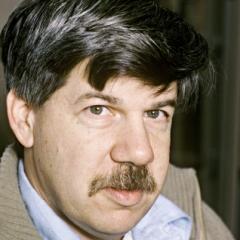
Stephen Jay Gould
Stephen Jay Gould

Stephen Jay Gould was a renowned paleontologist, evolutionary theorist, science writer, and academic. He is known for his work in ornithology, paleontology, evolutionary theory, and speciation. Gould's writings and papers have had a profound impact on the scientific community, and he was a long-time contributor to the journal 'Nature'. more

You May Also Like

“Antiessentialist thinking forces us to view the world differently. We must accept shadings and continua as fundamental. We lose criteria for judgment by comparison to some ideal: short people, retarded people, people of other beliefs, colors, and religions are people of full status.”

“The facts of nature are what they are, but we can only view them through the spectacles of our mind. Our mind works largely by metaphor and comparison, not always (or often) by relentless logic. When we are caught in conceptual traps, the best exit is often a change in metaphor not because the new guideline will be truer to nature (for neither the old nor the new metaphor lies "out there" in the woods), but because we need a shift to more fruitful perspectives, and metaphor is often the best agent of conceptual transition.”

“Good scholars struggle to understand the world in an integral way (pedants bite off tiny bits and worry them to death). These visions of reality [...] demand our respect, for they are an intellectual's only birthright. They are often entirely wrong and always flawed in serious ways, but they must be understood honorably and not subjected to mayhem by the excision of patches.”

“We debase the richness of both nature and our own minds if we view the great pageant of our intellectual history as a compendium of new information leading from primal superstition to final exactitude. We know that the sun is hub of our little corner of the universe, and that ties of genealogy connect all living things on our planet, because these theories assemble and explain so much otherwise disparate and unrelated information not because Galileo trained his telescope on the moons of Jupiter or because Darwin took a ride on a Galápagos tortoise.”

“Phony psychics like Uri Geller have had particular success in bamboozling scientists with ordinary stage magic, because only scientists are arrogant enough to think that they always observe with rigorous and objective scrutiny, and therefore could never be so fooled while ordinary mortals know perfectly well that good performers can always find a way to trick people.”

“When scientists need to explain difficult points of theory, illustration by hypothetical example - rather than by total abstraction - works well (perhaps indispensably) as a rhetorical device. Such cases do not function as speculations in the pejorative sense - as silly stories that provide insight into complex mechanisms - but rather as idealized illustrations to exemplify a difficult point of theory. (Other fields, like philosophy and the law, use such conjectural cases as a standard device.”

“Darwinian natural selection only yields adaptation to changing local environments, and better function in an immediate habitat might just as well be achieved by greater simplicity in form and behavior as by ever-increasing complexity.”