Quotessence
Home / Quotes / Quote by Charles Henry Parkhurst

Quote by Charles Henry Parkhurst

Author
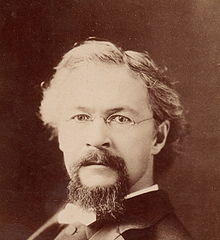
Charles Henry Parkhurst

Charles Henry Parkhurst (April 17, 1842 - September 8, 1933) was an American social reformer known for his work in child welfare and the temperance movement. His career and life experience are not well-documented. more

You May Also Like

“The scientific method of examining facts is not peculiar to one class of phenomena and to one class of workers; it is applicable to social as well as to physical problems, and we must carefully guard ourselves against supposing that the scientific frame of mind is a peculiarity of the professional scientist.”

“We [may] answer the question: "Why is snow white?" by saying, "For the same reason that soap-suds or whipped eggs are white"-in other words, instead of giving the reason for a fact, we give another example of the same fact. This offering a similar instance, instead of a reason, has often been criticised as one of the forms of logical depravity in men. But manifestly it is not a perverse act of thought, but only an incomplete one. Furnishing parallel cases is the necessary first step towards abstracting the reason imbedded in them all.”

“[Science] is not perfect. It can be misused. It is only a tool. But it is by far the best tool we have, self-correcting, ongoing, applicable to everything. It has two rules. First: there are no sacred truths; all assumptions must be critically examined; arguments from authority are worthless. Second: whatever is inconsistent with the facts must be discarded or revised. ... The obvious is sometimes false; the unexpected is sometimes true.”

“All interpretations made by a scientist are hypotheses, and all hypotheses are tentative. They must forever be tested and they must be revised if found to be unsatisfactory. Hence, a change of mind in a scientist, and particularly in a great scientist, is not only not a sign of weakness but rather evidence for continuing attention to the respective problem and an ability to test the hypothesis again and again.”