Quotessence
Home / Quotes / Quote by Joseph Murray

Quote by Joseph Murray

“It is probably no exaggeration to suppose that in order to improve such an organ as the eye at all, it must be improved in ten different ways at once. And the improbability of any complex organ being produced and brought to perfection in any such way is an improbability of the same kind and degree as that of producing a poem or a mathematical demonstration by throwing letters at random on a table.”

Quote by Joseph Murray

Author
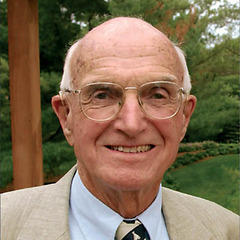
Joseph Murray
Joseph Murray

Joseph Murray was an American surgeon renowned for his pioneering work in organ transplantation. In 1954, he and his colleague Donald Thomas successfully performed the world's first kidney transplant, for which he was awarded the Nobel Prize in Physiology or Medicine in 1960. more

You May Also Like

“Lagrange, in one of the later years of his life, imagined that he had overcome the difficulty (of the parallel axiom). He went so far as to write a paper, which he took with him to the Institute, and began to read it. But in the first paragraph something struck him that he had not observed: he muttered: 'Il faut que j'y songe encore', and put the paper in his pocket.' [I must think about it again]”

“Mathematics had never had more than a secondary interest for him ; and even logic he cared for chiefly as a means of clearing the ground of doctrines imagined to be proved, by showing that the evidence on which they were supposed to rest had no tendency to prove them. But he had been endeavouring to give a more active and positive help than this to the cause of what he deemed pure religion.”

“On foundations we believe in the reality of mathematics, but of course, when philosophers attack us with their paradoxes, we rush to hide behind formalism and say 'mathematics is just a combination of meaningless symbols,'... Finally we are left in peace to go back to our mathematics and do it as we have always done, with the feeling each mathematician has that he is working with something real. The sensation is probably an illusion, but it is very convenient.”

“Plenty of mathematicians, Hardy knew, could follow a step-by-step discursus unflaggingly-yet counted for nothing beside Ramanujan. Years later, he would contrive an informal scale of natural mathematical ability on which he assigned himself a 25 and Littlewood a 30. To David Hilbert, the most eminent mathematician of the day, he assigned an 80. To Ramanujan he gave 100.”