Quotessence
Home / Quotes / Quote by Robinson Jeffers

Quote by Robinson Jeffers

“What is this thing called life? I believe That the earth and the stars too, and the whole glittering universe, and rocks on the mountains have life, Only we do not call it so--I speak of the life That oxidizes fats and proteins and carbo- Hydrates to live on, and from that chemical energy Makes pleasure and pain, wonder, love, adoration, hatred and terror: how do these things grow From a chemical reaction? I think they were here already, I think the rocks And the earth and the other planets, and the stars and the galaxies have their various consciousness, all things are conscious; But the nerves of an animal, the nerves and brain Bring it to focus; the nerves and brain are like a burning-glass To concentrate the heat and make it catch fire: It seems to us martyrs hotter than the blazing hearth From which it came. So we scream and laugh, clamorous animals Born howling to die groaning: the old stones in the dooryard Prefer silence; but those and all things have their own awareness, As the cells of a man have; they feel and feed and influence each other, each unto all, Like the cells of a man's body making one being, They make one being, one consciousness, one life, one God.”

Quote by Robinson Jeffers

Work

The Selected Poetry

Browse quotes and source details for this work. more

Author
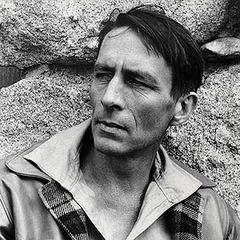
Robinson Jeffers
Robinson Jeffers

Robinson Jeffers was an American poet known for his majestic descriptions of nature and profound philosophical reflections. His poetry often explores the relationship between humans and the natural world, as well as reflections on modern civilization. more

You May Also Like

“Are Human, Support Human (Sonnet 2520) AI fakes will rise, AI fakes will fall, and you can never tell them apart, but one thing these vermin must be petrified of, is to be exposed - never tolerate AI slop as normal, just like you no longer tolerate the nazis as normal. To nourish creativity you must be intolerant of fakes, for humanity to flourish you must be intolerant of prejudice. Those who make AI fakes and those who knowingly consume them are equally garbage, those who howl prejudice and those who stay silent are equally savage. Some century when AI does become self aware, then we might have to reconsider our ethics, until then preserve human art at all cost, and banish every last AI slop in the bin.”

“Ben, for three thousand years architects designed buildings with columns shaped like female figures. At last Rodin pointed out that this was work too heavy for a girl. He didn't say, "Look, you jerks, if you have to do this, make it a brawny male figure." He showed it. This poor little caryatid has fallen under the load. She's a good girl—look at her face. Serious, unhappy at her failure, not blaming anyone, not even the gods. And still trying to shoulder her load after she has crumpled under it. But she is more than good art denouncing bad art. She is a symbol for every woman who ever shouldered a load too heavy. But not only women. This symbol means every man and woman who ever sweated out fortitude until they crumpled under their loads. It is courage, Ben, and victory. Victory? Victory in defeat, Ben—there is none higher. She is still trying to shoulder that stone long after it has crushed her.”

“L’ho perduto. È andato via quando il mio atto del filmare è stato contaminato dal vedere. La purezza dello sguardo è svanita. Si è fatta mera solitudine. I miei occhi sono serrati persi nella gioia del dolore. L’agonia dello sguardo è arrivata. Sento il suo peso dentro i miei occhi mentre le palpebre sono ancora chiuse. Non riesco più a vedere ma posso immaginarmi di guardare, oltre il buio.”

“In the burning house you continue to do what you had done before—but you cannot avoid seeing that the flames now show you bare. Something has changed, not in what you do but in the way in which you let it go in the world. A poem written in the burning house is truer, more right, because no one can hear it, because nothing ensures that it can escape the flames. But if, by chance, it finds a reader, then that reader will in no way be able to draw back from the apostrophe that calls out from that helpless, inexplicable, faint clamor. Only someone who is unlikely ever to be heard can tell the truth, only someone who speaks from within a house that the flames are relentlessly consuming.”

“Beyoncé spins her own bittersweet narratives into art. “I’ma rain, I’ma rain on this bitter love/Tell the sweet I’m new,” she sings on “Freedom.” As bell hooks writes of Beyoncé’s Lemonade in her essay “Moving Beyond Pain,” to be truly free, we must choose beyond simply surviving adversity, we must dare to create lives of sustained optimal well-being and joy. In that world, the making and drinking of lemonade will be a fresh and zestful delight, a real life mixture of the bitter and the sweet, and not a measure of our capacity to endure pain, but rather a celebration of our moving beyond pain.” If Will Cotton’s paintings—- resplendent with pure, idealized fantasy—- are the sweetness we lazily dream of, Walker’s A Subtlety is the sweetness we actually live: rearing up through centuries of hurt and exploitation, planting its feet in the good and the bad, the pleasure and the pain. It crystallizes across the surfaces of our imperfect lives, and makes us shine.”