Quotessence
Home / Quotes / Quote by Julian Jaynes

Quote by Julian Jaynes

Work

The Origin of Consciousness in the Breakdown of the Bicameral Mind

This book delves into the concept of the bicameral mind, a theory suggesting that early humans experienced a form of consciousness that was split between two parts of the brain. The author examines the implications of this theory on the development of human consciousness and society. more

Author
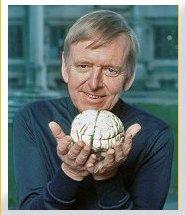
Julian Jaynes
Julian Jaynes

Julian Jaynes was a psychologist known for his hypothesis on the origin of human consciousness. His book 'The Origin of Consciousness in the Breakdown of the Bicameral Mind' proposed a theory that human consciousness experienced a shift from collective unconsciousness to individual consciousness around 1000 BCE. more

You May Also Like

“All faults or defects, from the slightest misconduct to the most flagitious crime, Pantocyclus attributed to some deviation from perfect Regularity in the bodily figure, caused perhaps (if not congenital) by some collision in a crowd; by neglect to take exercise, or by taking too much of it; or even by a sudden change of temperature, resulting in a shrinkage or expansion in some too susceptible part of the frame. Therefore, concluded that illustrious Philosopher, neither good conduct nor bad conduct is a fit subject, in any sober estimation, for either praise or blame. For why should you praise, for example, the integrity of a Square who faithfully defends the interests of his client, when you ought in reality rather to admire the exact precision of his right angles? Or again, why blame a lying, thievish Isosceles when you ought rather to deplore the incurable inequality of his sides? Theoretically, this doctrine is unquestionable; but it has practical drawbacks. In dealing with an Isosceles, if a rascal pleads that he cannot help stealing because of his unevenness, you reply that for that very reason, because he cannot help being a nuisance to his neighbours, you, the Magistrate, cannot help sentencing him to be consumed - and there's an end of the matter. But in little domestic difficulties, where the penalty of consumption, or death, is out of the question, this theory of Configuration sometimes comes in awkwardly; and I must confess that occasionally when one of my own Hexagonal Grandsons pleads as an excuse for his disobedience that a sudden change of the temperature has been too much for his perimeter, and that I ought to lay the blame not on him but on his Configuration, which can only be strengthened by abundance of the choicest sweetmeats, I neither see my way logically to reject, nor practically to accept, his conclusions. For my own part, I find it best to assume that a good sound scolding or castigation has some latent and strengthening influence on my Grandson's Configuration; though I own that I have no grounds for thinking so. At all events I am not alone in my way of extricating myself from this dilemma; for I find that many of the highest Circles, sitting as Judges in law courts, use praise and blame towards Regular and Irregular Figures; and in their homes I know by experience that, when scolding their children, they speak about "right" or "wrong" as vehemently and passionately as if they believed that these names represented real existences, and that a human Figure is really capable of choosing between them.”

“Our knowledge springs from two fundamental sources of our mind; the first is to receive representations (receptivity of impressions), the second is the faculty of knowing an object through these representations (spontaneity of concepts). Through the first an object is *given* to us, through the second the object is *thought* in relation to that representation (which is a mere determination of the mind). Intuition and concepts constitute, therefore, the elements of all our knowledge, so that neither concepts without an intuition in some way corresponding to them, nor intuition without concepts can yield knowledge. Both are either pure or empirical. They are empirical when they contain sensation (sensation presupposes the actual presence of the object). They are *pure* when no sensation is mixed in with the representation. Sensation may be called the matter of sensible knowledge. Pure intuition, therefore, contains only the form under which something is intuited, and the pure concepts contains only the form of thinking an object in general. Pure intuitions and pure concepts alone are possible *a priori*, empirical intuitions and empirical concepts only *a posteriori*. We call *sensibility* the *receptivity* of our mind to receive representations insofar as it is in some wise affected, while the *understanding*, on the other hand, is our faculty of producing representations by ourselves, or the *spontaneity* of knowledge. We are so constituted that our intuition can never be other than *sensible*; that is, it contains only the mode in which we are affected by objects. The faculty, on the contrary, which enables us to *think* the object of sensible intuition is the *understanding*. Neither of these properties is to be preferred to the other. Without sensibility no object would be given to us, without understanding no object would be thought. Thoughts without content are empty, intuitions without concepts are blind. It is, therefore, just as necessary to make our concepts sensible (i.e., to add the object to them in intuition) as to make our intuitions understandable (i.e., to bring them under concepts). These two faculties or capacities cannot exchange their functions. The understanding cannot intuit anything, the senses cannot think anything. Only from their union can knowledge arise. But this is no reason for confounding their respective contributions; rather, it gives us a strong reason for carefully separating and distinguishing the one from the other. We therefore distinguish the science of the rules of sensibility in general, i.e., aesthetic, from the science of the rules of the understanding in general, i.e., logic." ―Transcendental Doctrine of Elements. Transcendental Logic: The Idea of a Transcendental Logic”