Quotessence
Home / Quotes / Quote by Saul Alinsky

Quote by Saul Alinsky

“The sit-down strikers began to worry about the illegality of their action and the why and wherefore, and it was then the chief of all C.I.O. organizers, Lewis, gave them their rationale. He thundered, 'The right to a man's job transcends the right of private property! The C.I.O. stands squarely behind these sit-downs!' The sit-down strikers at GM cheered.”

Quote by Saul Alinsky

Work

Rules for Radicals: A Pragmatic Primer for Realistic Radicals

This book provides a comprehensive framework for political activism, detailing various strategies and tactics employed by radicals and activists. It explores the principles and methods used to influence social change and is considered a foundational text in the field of political organizing. more

Author
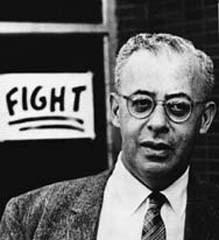
Saul Alinsky
Saul Alinsky

Saul Alinsky was an American writer and community organizer recognized for his seminal work in the realm of social activism. He is predominantly known for his seminal book 'Rules for Radicals', which has profoundly influenced contemporary political tactics and community organizing principles. more

You May Also Like

“The chief signifi cance of the comprehensive systems of unemployment compensation that have been adopted in all Western countries, however, is that they operate in a labor market dominated by the coercive action of unions and that they have been designed under strong union influence with the aim of assisting the unions in their wage policies. A system in which a worker is regarded as unable to fi nd employment and therefore is entitled to benefit because the workers in the fi rm or industry in which he seeks employment are on strike necessarily becomes a major support of union wage pressure. Such a system, which relieves the unions of the responsibility for the unemployment that their policies create and which places on the state the burden not merely of maintaining but of keeping content those who are kept out of jobs by them, can in the long run only make the employment problem more acute.”

“The Australian union movement called an 'illegal' general strike in 1976, when Prime Minister Malcolm Fraser's government was trying to destroy our embryonic universal healthcare system. That strike brought the country to a standstill. Fraser backed down, and what became Medicare remains. The same people who disagree [with strike action] may also want to reflect on this the next time they enjoy a leisurely weekend, or are saved from an accident by workplace safety standards, or knock off work after an eight-hour shift. Union members won all these conditions in campaigns that were deemed 'illegal' industrial actiona at the time. These union members built the living standards we all enjoy. They should be celebrated and thanked for their bravery and sacrifices, not condemned and renounced.”

“Called by the fattoria committee, the unemployed braccianti arrive in force on the lands that the owners refuse to improve. In spite of the presence of the owners, the superintendents, or their agents, the workers carry out the work; they then demand their salary (pay ble to the legal investment fund). In the backwards strike, the workers work against the wishes of the boss, and their work increases the productivity of the soil. This is doubly paradoxical when compared to the conventional notion of the strike. Thus, at Empoli, between Florence and Sienna, 70,000 cubic meters of grading, ditches, and other work has been carried out by the "strikers" under the direction of the fattorie committees. The latter paid the workers directly, withdrawing 4% from the money deposited by them into the bank and representing the sale of farm products. in all the areas of Tuscany where the committees are active, they have organized the planting of vines, the work of drainage or irrigation, the repair of buildings, and whatever else might be required. They even established, in individual locations, nascent production cooperatives for clearing the land and improving uncultivated or poorly cultivated soil, which assumes their presence on these lands notwithstanding the will of the owner.”