Quotessence
Home / Quotes / Quote by Mark Twain

Quote by Mark Twain

Work

Following the Equator - Part 7

Browse quotes and source details for this work. more

Author
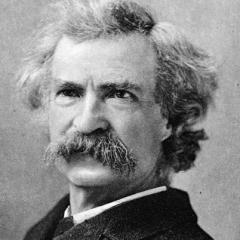
Mark Twain
Mark Twain

Mark Twain, born Samuel Langhorne Clemens, was a renowned American author and humorist in the 19th century. His works are characterized by humor, satire, and profound social insight, with notable novels such as 'The Adventures of Tom Sawyer' and 'The Adventures of Huckleberry Finn'. more

You May Also Like

“Some colonies were even reputed as being paradises of homosexual debauchery. Indeed, in French, faire passer son brevet colonial, that is, to take one's colonial certificate, mean initiating a young recruit to sodomy, that is, intercourse ,i> per anum during which the noviciate would play the role of the insertee.”

“To call the belief in substantial human equality a superstition is to insult superstition. It might be unwarranted to believe in leprechauns, but at least the person who holds to such a belief isn’t watching them not exist, for every waking hour of the day. Human inequality, in contrast, and in all of its abundant multiplicity, is constantly on display, as people exhibit their variations in gender, ethnicity, physical attractiveness, size and shape, strength, health, agility, charm, humor, wit, industriousness, and sociability, among countless other features, traits, abilities, and aspects of their personality, some immediately and conspicuously, some only slowly, over time. To absorb even the slightest fraction of all this and to conclude, in the only way possible, that it is either nothing at all, or a ‘social construct’ and index of oppression, is sheer Gnostic delirium: a commitment beyond all evidence to the existence of a true and good world veiled by appearances. People are not equal, they do not develop equally, their goals and achievements are not equal, and nothing can make them equal. Substantial equality has no relation to reality, except as its systematic negation. Violence on a genocidal scale is required to even approximate to a practical egalitarian program, and if anything less ambitious is attempted, people get around it (some more competently than others).”

“...she had little use for separate but so-called equal. My mother understood from her Southern roots a basic principle that still rings true; where there's a white presence, there will be amenities. She wanted grocery stores with quality produce, and roads that got repaired and streeetlights that came on magically at dusk and garbage that got collectd on time.”

“Unlike most models of interpersonal networks, the one presented here is not meant primarily for application to small, face-to-face groups or to groups in confined institutional or organizational settings. Rather, it is meant for linkage of such small-scale levels with one another and with larger, more amorphous ones. This is why emphasis here has been placed more on weak ties than on strong. Weak ties are more likely to link members of different small groups than are strong ones, which tend to be concentrated within particular groups. [...] The major implication intended by this paper is that the personal experience of individuals is closely bound up with larger-scale aspects of social structure, well beyond the purview or control of particular individuals. Linkage of micro and macro levels is thus no luxury but of central importance to the development of sociological theory. Such linkage generates paradoxes: weak ties, often denounced as generative of alienation, are here seen as indispensable to individuals' opportunities and to their integration into communities; strong ties, breeding local cohesion, lead to overall fragmentation. Paradoxes are a welcome antidote to theories which explain everything all too neatly.”