“Never elated while one man's oppress'd; Never dejected while another's blessed.”
Quote by Alexander Pope
Work
The works of Alexander Pope. With notes by dr. Warburton
This volume includes a selection of Alexander Pope's most renowned works, such as 'The Rape of the Lock' and 'An Essay on Man,' along with critical notes by Dr. Thomas Warton, providing historical context and analysis. more
Author
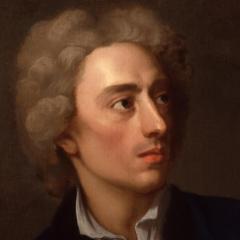
Alexander Pope
Alexander Pope, an English poet, was born on May 21, 1688, and died on May 30, 1744. He is renowned for his wit, satire, and elegant poetry, with his most famous works including 'An Essay on Criticism' and 'The Moral Essays'. Pope's works have had a profound impact on literature and philosophy, both in his time and today. more
You May Also Like
“Talk what you will of taste, my friend, you'll find two of a face as soon as of a mind.”
Source: The Works of Alexander Pope, Esq: Satires. On receiving from the Right Honourable the Lady Frances Shirley, a standish and two pens. A fragment of an unpublished satire of Pope intitled One thousand seven hundred and forty. The plan of an epic poem, to have been written in blank verse, and intitled Brutus. Preface to Homer's Iliad. Postscript to the Odyssey
“Taste, that eternal wanderer, which flies From head to ears, and now from ears to eyes.”
Source: Delphi Complete Works of Alexander Pope (Illustrated)
“I am satisfied to trifle away my time, rather than let it stick by me.”
Source: The Works of Alexander Pope: New Ed. Including Several Hundred Unpublished Letters, and Other New Materials, Collected in Part by John Wilson Croker. With Introd. and Notes by Whitwell Elwin
“Still when the lust of tyrant power succeeds, some Athens perishes, or some Tully bleeds.”
Source: The Poetical Works of Alexander Pope Edited with Notes and Introductory Memoir by Adolphus William Ward
“That each from other differs, first confess; next that he varies from himself no less.”
Source: The Works of Alexander Pope
“The lights and shades, whose well-accorded strife gives all the strength and color of our life.”
Source: An Essay on Man: In Four Epistles, to H.St.John, Lord Bolingbroke
Source: An Essay on Man: And Other Poems
Source: An Essay on Man: In Four Epistles, to H. St. John, Lord Bolingbroke
“Sometimes virtue starves while vice is fed.”
Source: The works of Alexander Pope, with notes and illustrations, by himself and others. To which are added, a new life of the author [&c.] by W. Roscoe
Source: The works of Alexander Pope, with notes and illustrations, by himself and others. To which are added, a new life of the author [&c.] by W. Roscoe