“The authour who imitates his predecessors only by furnishing himself with thoughts and elegances out of the same general magazine of literature, can with little more propriety be reproached as a plagiary, than the architect can be censured as a mean copier of Angelo or Wren, because he digs his marble out of the same quarry, squares his stones by the same art, and unites them in columns of the same orders.”
Quote by Samuel Johnson
Work
The Rambler: A Periodical Paper, Published in 1750, 1751, 1752
The Rambler is a series of periodical papers that were published in three separate volumes, spanning the years 1750, 1751, and 1752. Each volume consists of a variety of essays and articles, covering a range of topics including social issues, literature, and philosophy. The work is notable for its contribution to the development of the essay form and its influence on subsequent literary works. more
Author
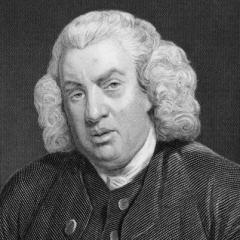
Samuel Johnson
Samuel Johnson was an English writer, poet, and lexicographer, renowned for his comprehensive English dictionary, 'A Dictionary of the English Language', published in 1755. His distinctive writing style and wit have cemented his place as a significant figure in the history of English literature. more
You May Also Like
Source: The Works of Samuel Johnson, LL.D.: With Murphy's Essay
Source: The Beauties of Johnson: Consisting of Maxims and Observations, Moral, Critical, and Miscellaneous
Source: Selected essays
Source: The Rambler: A Periodical Paper, Published in 1750, 1751, 1752
“Some people regard discipline as a chore. For me, it is a kind of order that sets me free to fly.”
“Real progress is progress in charity, all other advances being secondary thereto.”
“A man is original when he speaks the truth that has always been known to all good men.”
Source: Collected Pruse