Quotessence
Home / Quotes / Quote by Meghan Daum

Quote by Meghan Daum

“For so long, maybe all my life, I thought only a house could make you whole. I thought I was nothing without an interesting address. I thought I was only as good as my color scheme, my drawer pulls, my floors....it's the knowledge that a house can be as fragile as life itself. You'd think it would be stronger, since it can stand in one spot for centuries while generations of humans run through tis rooms, grow up, move out, and eventually die. But a house is an inherently limited entity. It can't do everything, or even most things. I t cannot give you a personality. It cannot bring you love. It cannot cure loneliness. It can provide comfort, safety, a sense of pride--that much I know.”

Quote by Meghan Daum

Author
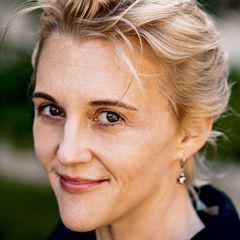
Meghan Daum
Meghan Daum

Meghan Daum is an American author born in 1970. Her works are known for their unique perspective and insightful analysis, covering a wide range of topics from personal experiences to cultural commentary and social observation. more

You May Also Like

“I wonder if the real measure of "home" is the degree to which you can leave it alone. Maybe appreciating a house means knowing when to stop decorating. Maybe you've never really lived there until you've thrown its broken pieces in the garbage. Maybe learning how to be out in the big world isn't the epic journey everyone thinks it is. Maybe that's actually the easy part. The hard part is what's right in front of you. The hard part is learning how to hold the title to your very existence, to own not only property, but also your life. The hard part is learning not just how to be but mastering the nearly impossible art of how to be at home.”

“Light and the human is poorly understood by the astronomical profession, with many astronomers not understanding which light bulbs they should have in their own homes and offices! It is embarrassing that astronomers do not understand the many forms of artificial lighting that they are exposed to every day and how it affects them.”

“Like most people, when I look back, the family house is held in time, or rather it is now outside of time, because it exists so clearly and it does not change, and it can only be entered through a door in the mind. I like it that pre-industrial societies, and religious cultures still, now, distinguish between two kinds of time – linear time, that is also cyclical because history repeats itself, even as it seems to progress, and real time, which is not subject to the clock or the calendar, and is where the soul used to live. This real time is reversible and redeemable. It is why, in religious rites of all kinds, something that happened once is re-enacted – Passover, Christmas, Easter, or, in the pagan record, Midsummer and the dying of the god. As we participate in the ritual, we step outside of linear time and enter real time. Time is only truly locked when we live in a mechanised world. Then we turn into clock-watchers and time-servers. Like the rest of life, time becomes uniform and standardised. When I left home at sixteen I bought a small rug. It was my roll-up world. Whatever room, whatever temporary place I had, I unrolled the rug. It was a map of myself. Invisible to others, but held in the rug, were all the places I had stayed – for a few weeks, for a few months. On the first night anywhere new I liked to lie in bed and look at the rug to remind myself that I had what I needed even though what I had was so little. Sometimes you have to live in precarious and temporary places. Unsuitable places. Wrong places. Sometimes the safe place won’t help you. Why did I leave home when I was sixteen? It was one of those important choices that will change the rest of your life. When I look back it feels like I was at the borders of common sense, and the sensible thing to do would have been to keep quiet, keep going, learn to lie better and leave later. I have noticed that doing the sensible thing is only a good idea when the decision is quite small. For the life-changing things, you must risk it. And here is the shock – when you risk it, when you do the right thing, when you arrive at the borders of common sense and cross into unknown territory, leaving behind you all the familiar smells and lights, then you do not experience great joy and huge energy. You are unhappy. Things get worse. It is a time of mourning. Loss. Fear. We bullet ourselves through with questions. And then we feel shot and wounded. And then all the cowards come out and say, ‘See, I told you so.’ In fact, they told you nothing.”