Quotessence
Home / Quotes / Quote by Jung Chang

Quote by Jung Chang

“Like many Chinese, I was incapable of rational thinking in those days. We were so cowed and contorted by fear and indoctrination that to deviate from the path laid down by Mao would have been inconceivable. Besides, we had been overwhelmed by deceptive rhetoric, disinformation, and hypocrisy, which made it virtually impossible to see through the situation and to form an intelligent judgment.”

Quote by Jung Chang

Work

Wild Swans: Three Daughters of China

This memoir offers an intimate look into the lives of three sisters from China, spanning the tumultuous decades of the 20th century. The narrative delves into the personal and political transformations they experienced, reflecting the broader shifts in Chinese society during this time. more

Author
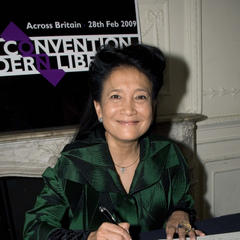
Jung Chang
Jung Chang

Renowned historian and writer, author of 'China: A History' and 'Wild Swans', among others. She analyzes Chinese history and culture with a unique perspective and profound insight, winning wide acclaim worldwide. more

You May Also Like

“Tiffany learned that Lin had stolen Tiffany’s book title idea: “2 girls 1 cup.” A month ago, Tiffany had confided to Lin about Tiffany’s research showing that there was nothing on Amazon with the title “2 girls 1 cup,” and Tiff intended to be the first one to use that title for her upcoming book. Lin had betrayed her. Now, Lin’s book was available online and it was on the bestsellers list. Tiffany’s first go-to move for revenge against any of her female friends was to go sleep with her BFF’s boyfriend. That was “Dr. Bob” as Lin called him affectionately (he was Lin’s drug source).”

“As times change and social mechanisms evolve, it seems to me, different survival instincts come into play. In social terms the Cultural Revolution was a simple era whereas today's society is complex and chaotic. One of Mao Zedong's remarks sums up a basic characteristic of the Cultural Revolution. 'We should support whatever the enemy opposes,' he said. 'and oppose whatever the enemy supports.' The Cultural Revolution was an era when everything was painted in black and white, when the eney was always wrong and we were always right; nobody had the courage to suggest that the enemy might sometimes be right and we might be sometimes be wrong. Deng Xiaoping, in turn, said something that captures the zeitgeist of our current age: 'A cat that catches the mouse is a good cat, no matter whether it is black or white.' In so saying, he overturned Mao's system of values and pointed out a fact long evident in Chinese society: right and wrong often coexist in a single phenomenon and interact in a dynamic of mutual displacement. At the same time, his comment put an end to the argument about where socialism and capitalism belong in China's economic development. So China moved from Mao Zedong's monochrome era of politics-in-command to Deng Xiaoping's polychrome era of economics above all.”

“As times change and social mechanisms evolve, it seems to me, different survival instincts come into play. In social terms the Cultural Revolution was a simple era whereas today's society is complex and chaotic. One of Mao Zedong's remarks sums up a basic characteristic of the Cultural Revolution. 'We should support whatever the enemy opposes,' he said. 'and oppose whatever the enemy supports.' The Cultural Revolution was an era when everything was painted in black and white, when the enemy was always wrong and we were always right; nobody had the courage to suggest that the enemy might sometimes be right and we might be sometimes be wrong. Deng Xiaoping, in turn, said something that captures the zeitgeist of our current age: 'A cat that catches the mouse is a good cat, no matter whether it is black or white.' In so saying, he overturned Mao's system of values and pointed out a fact long evident in Chinese society: right and wrong often coexist in a single phenomenon and interact in a dynamic of mutual displacement. At the same time, his comment put an end to the argument about where socialism and capitalism belong in China's economic development. So China moved from Mao Zedong's monochrome era of politics-in-command to Deng Xiaoping's polychrome era of economics above all.”

“Remember that you are love. The society wants you to forget that you are love. The society creates all kinds conditionings, so that you will not remember that you are love. Jesus says that God is love. If God is love it means that all is love, because all comes from God. Bit the society lives on hate, anger, greed, ambition, power, violence and war. War is the way of society. Society is very animalistic. Even animals are not so ugly. Animals have a grace, which man has lost. Meditation means to be initiated into love. Meditation and love are synonymous words. If you can love, then God is not far away. Then God is in the heartbeat of your being. Wherever love is, God is. Love is the fragrance of God.”

“Mao’s touch acquired otherworldly significance: when a Pakistani delegation gave Mao a basket of mangoes in 1968, he regifted them to workers, who wept and placed them on altars; crowds lined up and bowed before the fruit. A mango was flown to Shanghai on a chartered plane, so that workers such as Wang Xiaoping could see it. “What is a ‘mango’? Nobody knew,” she recalled in an essay. “Knowledgeable people said it was a fruit of extreme rarity, like Mushrooms of Immortality.” When the mangoes spoiled, they were preserved in formaldehyde, and plastic replicas were created. A village dentist who observed that one of the mangoes resembled a sweet potato was tried for malicious slander and executed.”