Quotessence
Home / Quotes / Quote by Friedrich Nietzsche

Quote by Friedrich Nietzsche

“I and me are always too deeply in conversation: how could I endure it, if there were not a friend? The friend of the hermit is always the third one: the third one is the float which prevents the conversation of the two from sinking into the depth.”

Quote by Friedrich Nietzsche

Work

Thus Spoke Zarathustra

Thus Spoke Zarathustra is a philosophical novel that delves into profound themes such as the will to power, the eternal recurrence, and the concept of the Übermensch. The book is a collection of aphorisms and dialogues narrated by the character Zarathustra, who seeks to inspire others to embrace life and strive for self-overcoming. Written by the German philosopher Friedrich Nietzsche, the work is considered a cornerstone of modern Western philosophy. more

Author
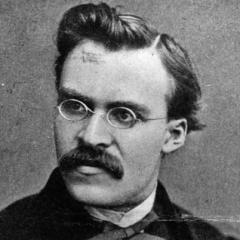
Friedrich Nietzsche
Friedrich Nietzsche

Friedrich Nietzsche was a German philosopher, cultural critic, poet, and writer whose works have had a profound impact on subsequent philosophy, literature, and thought. His ideas revolve around concepts such as the 'will to power', the 'Übermensch', and the 'eternal recurrence'. more

You May Also Like

“A good movie can take you out of your dull funk and the hopelessness that so often goes with slipping into a theatre; a good movie can make you feel alive again, in contact, not just lost in another city. Good movies make you care, make you believe in possibilities again. If somewhere in the Hollywood-entertainment world someone has managed to break through with something that speaks to you, then it isn’t all corruption. The movie doesn’t have to be great; it can be stupid and empty and you can still have the joy of a good performance, or the joy in just a good line. An actor’s scowl, a small subversive gesture, a dirty remark that someone tosses off with a mock-innocent face, and the world makes a little bit of sense. Sitting there alone or painfully alone because those with you do not react as you do, you know there must be others perhaps in this very theatre or in this city, surely in other theatres in other cities, now, in the past or future, who react as you do. And because movies are the most total and encompassing art form we have, these reactions can seem the most personal and, maybe the most important, imaginable. The romance of movies is not just in those stories and those people on the screen but in the adolescent dream of meeting others who feel as you do about what you’ve seen. You do meet them, of course, and you know each other at once because you talk less about good movies than about what you love in bad movies.”

“And I'm hoping there's some larger truth about suffering here, or at least my understanding of it - although I've come to realize that the only truths that matter to me are the ones I don't, and can't, understand. What's mysterious, ambiguous, inexplicable. What doesn't fit into a story, what doesn't have a story. Glint of brightness on a barely-there chain. Patch of sunlight on a yellow wall. The loneliness that separates every living creature from every other living creature. Sorrow inseparable from joy.”

“They are so caught up in their happiness that they don't realize I'm not really a part of it. I am wandering along the periphery. I am like the people in the Winslow Homer paintings, sharing the same room with them but not really there. I am like the fish in the aquarium, thinking in a different language, adapting to a life that's not my natural habitat. I am the people in the other cars, each with his or her own story, but passing too quickly to be noticed or understood. . . . There are moments I just sit in my frame, float in my tank, ride in my car and say nothing, think nothing that connects me to anything at all.”