Quotessence
Home / Quotes / Quote by E. O. Wilson

Quote by E. O. Wilson

“From the freedom to explore comes the joy of learning. From knowledge acquired by personal initiative arises the desire for more knowledge. And from mastery of the novel and beautiful world awaiting every child comes self-confidence.”

Quote by E. O. Wilson

Author
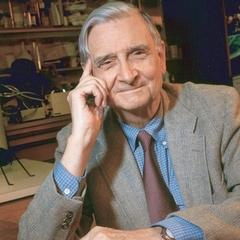
E. O. Wilson
E. O. Wilson

E. O. Wilson is a renowned American biologist, born on June 10, 1929. He has made significant contributions to the fields of entomology, sociobiology, and anthropology. Best known for his research on ants, he is often referred to as the 'father of ants'. His book 'Sociobiology: The New Science' had a profound impact on both biology and the social sciences. more

You May Also Like

“Groups do not have experiences except insofar as all their members do. And there are no experiences... that all the members of a scientific community must share in the course of a [scientific] revolution. Revolutions should be described not in terms of group experience but in terms of the varied experiences of individual group members. Indeed, that variety itself turns out to play an essential role in the evolution of scientific knowledge.”

“His [Thomas Edison] method was inefficient in the extreme, for an immense ground had to be covered to get anything at all unless blind chance intervened and, at first, I was almost a sorry witness of his doings, knowing that just a little theory and calculation would have saved him 90 per cent of the labor. But he had a veritable contempt for book learning and mathematical knowledge, trusting himself entirely to his inventor's instinct and practical American sense. In view of this, the truly prodigious amount of his actual accomplishments is little short of a miracle.”

“I am almost thanking God that I was never educated, for it seems to me that 999 of those who are so, expensively and laboriously, have lost all before they arrive at my age-& remain like Swift's Stulbruggs-cut and dry for life, making no use of their earlier-gained treasures:-whereas, I seem to be on the threshold of knowledge.”

“I am convinced that it is impossible to expound the methods of induction in a sound manner, without resting them upon the theory of probability. Perfect knowledge alone can give certainty, and in nature perfect knowledge would be infinite knowledge, which is clearly beyond our capacities. We have, therefore, to content ourselves with partial knowledge - knowledge mingled with ignorance, producing doubt.”