Quotessence
Home / Quotes / Quote by Gilbert K. Chesterton

Quote by Gilbert K. Chesterton

Author

Gilbert K. Chesterton

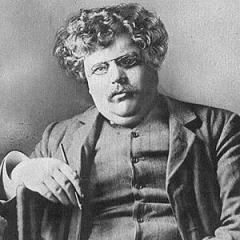
Gilbert K. Chesterton was an English writer, critic, and theologian, born on May 29, 1874, and died on June 14, 1936. Known for his unique literary style and profound philosophical thinking, Chesterton's works spanned a variety of genres, including novels, poetry, drama, and criticism. more

You May Also Like

“There is no reason to believe ... that the "essential purpose" of language is "communication". Language can be used to transmit information, but it also serves many other purposes: to establish relations among people, to express or clarify thought, for play, for creative mental activity, to gain understanding, and so on. In my opinion, there is no reason to accord privileged status to one or the other of these modes.”

“For centuries, we in the West have thought of ourselves as rational animals whose mental capacities transcend our bodily nature. In this traditional view our minds are abstract, logical, unemotionally rational, consciously accessible, and, above all, able to directly fit and represent the world. Language has a special place in thie view of what a human is - it is a privileged, logical symbol system internal to our minds that transparently expresses abstract concepts that are defined in terms of the external world itself.”

“Near the end of the 1700s, philosophers began to declare that humans were rational individuals. People were flattered by being recognized as individuals, and by being called rational, and the idea soon wormed its way into the belief systems of nearly everyone in the upper class. Despite resistance from Church and State, the idea of rational individuality replaced the assumption that truth comes only from god and king.”

“I wish to boast that Pygmalion has been an extremely successful play all over Europe and North America as well as at home. It is so intensely and deliberately didactic, and its subject is esteemed so dry, that I delight in throwing it at the heads of the wiseacres who repeat the parrot cry that art should never be didactic. It goes to prove my contention that art should never be anything else.”

“Perhaps I had better inform my Protestant readers that the famous Dogma of Papal Infallibility is by far the most modest pretension of the kind in existence. Compared with our infallible democracies, our infallible medical councils, our infallible astronomers, our infallible judges, and our infallible parliaments, the Pope is on his knees in the dust confessing his ignorance before the throne of God, asking only that as to certain historical matters on which he has clearly more sources of information open to him than anyone else his decision shall be taken as final.”

“The medieval doctors of divinity who did not pretend to settle how many angels could dance on the point of a needle cut a very poor figure as far as romantic credulity is concerned beside the modern physicists who have settled to the billionth of a millimetre every movement and position in the dance of the electrons. Not for worlds would I question the precise accuracy of these calculations or the existence of electrons (whatever they may be). The fate of Joan is a warning to me against such heresy.”