Quotessence
Home / Quotes / Quote by William Crookes

Quote by William Crookes

“...Nature-the word that stands for the baffling mysteries of the Universe. Steadily, unflinchingly, we strive to pierce the inmost heart of Nature, from what she is to reconstruct what she has been, and to prophesy what she yet shall be. Veil after veil we have lifted, and her face grows more beautiful, august, and wonderful, with every barrier that is withdrawn.”

Quote by William Crookes

Author
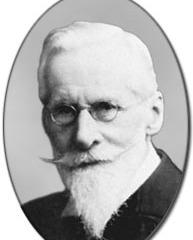
William Crookes
William Crookes

William Crookes, a British chemist, was born on June 17, 1832, and died on April 4, 1919. Known for his research in chemistry, physics, and astronomy, Crookes made significant contributions to the understanding of gas discharge and radioactivity, which had a profound impact on subsequent scientists. more

You May Also Like

“The more I study nature, the more I become impressed with ever-increasing force with the conclusion, that the contrivances and beautiful adaptations slowly acquired through each part occasionally varying in a slight degree but in many ways, with the preservation or natural selection of those variations which are beneficial to the organism under the complex and ever-varying conditions of life, transcend in an incomparable degree the contrivances and adaptations which the most fertile imagination of man could suggest with unlimited time at his disposal.”

“Nature is beautiful, and you are in her bosom. That voice of comfort which speaks in the breezes of morning, may visit your mind, that the delightful influences which the green leaves, the blue sky, the moonbeams and clouds of the evening diffuse over the universe, may in their powers of soul-healing, visit your day visions, is my desire and hope.”

“The whole language of nature informs us, that in animated beings there is something above our powers of investigation; something which employs, combines, and arranges the gross elements of matter - a spark of celestial fire, by which life is kindled and preserved, and which, if even the instruments it employs are indestructible in their essence, must itself, of necessity, be immortal.”

“The true wisdom of the philosopher ought to insist in enjoying everything. Yet we apply ourselves to dissecting and destroying everything that is good in itself, that has virtue, albeit the virtue there is in mere illusions. Nature gives us this life like a toy to a weak child. We want to see how it all works; we break everything. There remains in our hands, and before our eyes, stupid and opened too late, the sterile wreckage, fragments that will not again make a whole. The good is so simple.”