Quotessence
Home / Quotes / Quote by Symeon the New Theologian

Quote by Symeon the New Theologian

“But, being Himself at once God and man, His flesh and soul were and are holy - and beyond holy. God is holy, just as He was and is and shall be, and the Virgin is immaculate, without spot or stain, and so, too, was that rib which was taken from Adam. However, the rest of humanity, even though they are His brothers and kin according to the flesh, yet remained even as they were, of dust, and did not immediately become holy and sons of God.”

Quote by Symeon the New Theologian

Work

Author

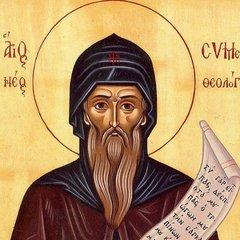
Symeon the New Theologian

Symeon the New Theologian (949–1022) was a Byzantine Christian mystic, poet, and theologian. Known for his emphasis on direct personal experience of God, he is one of three saints in Eastern Orthodoxy honored as 'Theologian.' His works include hymns, sermons, and theological writings that profoundly influenced Christian mysticism. more

You May Also Like

“But the work which most richly embroidered the gospel narratives and was destined to exert a tremendous influence on later Mariology was the Protoevangelium of James. Written for Mary's glorification, this described her divinely ordered birth when her parents, Joachim and Anna, were advanced in years, her miraculous infancy and childhood, and her dedication to the Temple, where her parents had prayed that God would give her 'a name renowned for ever among all generations'. It made the point that when she was engaged to Joseph he was already an elderly widower with sons of his own; and it accumulated evidence both that she had conceived Jesus without sexual intercourse and that her physical nature had remained intact when she bore Him. These ideas were far from being immediately accepted in the Church at large. Iranaeus, it is true, held that Mary's childbearing was exempt from physical travail, as did Clement of Alexandria (appealing to the Protoevangelium of James). Tertullian, however, repudiated the suggestion, finding the opening of her womb prophesied in Exodus 13, 2, and Origen followed him and argued that she had needed the purification prescribed by the Law. On the other hand, while Tertullian assumed that she had had normal conjugal relations with Joseph after Jesus's birth, the 'brethren of the Lord' being his true brothers, Origen maintained that she had remained a virgin for the rest of her life('virginity post partum') and that Jesus's so-called brothers were sons of Joseph but not by her...In contrast to the later belief in her moral and spiritual perfection, none of these theologians had the least scruple about attributing faults to her. Irenaeus and Tertullian recalled occasions on which, as they read the gospel stories, she had earned her Son's rebuke, and Origen insisted that, like all human beings, she needed redemption from her sins; ...”

“She gently placed her palm on my wounded shoulder and the warmth of her hand did nearly as much to soothe the ache as did the ointment. If only she would continue touching me, allow us to forge something new together from the broken pieces of our past. Her willing presence in my life would be far more healing than any balm”

“Most of all, however, these observances attack and undermine the very spirit of life within the minds of men. They afford to our Romans, from the street sweepers to the consuls, a vague sense of confidence where no confidence is and at the same time a pervasive fear, a fear which neither arouses to action nor calls forth ingenuity, but which paralyzes. They remove from men's shoulders the unremitting obligation to create, moment by moment, their own Rome. They come to us sanctioned by the usage of our ancestors and breathing the security of our childhood; they flatter passivity and console inadequacy”