“They're kidding themselves, of course. Our sky can go from lapis to tin in the blink of an eye. Blink again and your latte's diluted. And that's just fine with me. I thrive here on the certainty that no matter how parched my glands, how anhydrous the creek beds, how withered the weeds in the lawn, it's only a matter of time before the rains come home. The rains will steal down from the Sasquatch slopes. They will rise with the geese from the marshes and sloughs. Rain will fall in sweeps, it will fall in drones, it will fall in cascades of cheap Zen jewelry. And it will rain a fever. And it will rain a sacrifice. And it will rain sorceries and saturnine eyes of the totem. Rain will primitivize the cities, slowing every wheel, animating every gutter, diffusing commercial neon into smeary blooms of esoteric calligraphy. Rain will dramatize the countryside, sewing pearls into every web, winding silk around every stump, redrawing the horizon line with a badly frayed brush dipped in tea and quicksilver. And it will rain an omen. And it will rain a trance. And it will rain a seizure. And it will rain dangers and pale eggs of the beast. Rain will pour for days unceasing. Flooding will occur. Wells will fill with drowned ants, basements with fossils. Mossy-haired lunatics will roam the dripping peninsulas. Moisture will gleam on the beak of the Raven. Ancient shamans, rained from their rest in dead tree trunks, will clack their clamshell teeth in the submerged doorways of video parlors. Rivers will swell, sloughs will ferment. Vapors will billow from the troll-infested ditches, challenging windshield wipers, disgusing intentions and golden arches. Water will stream off eaves and umbrellas. It will take on the colors of beer signs and headlamps. It will glisten on the claws of nighttime animals. And it will rain a screaming. And it will rain a rawness. And it will rain a disorder, and hair-raising hisses from the oldest snake in the world. Rain will hiss on the freeways. It will hiss around the prows of fishing boats. It will hiss in the electrical substations, on the tips of lit cigarettes, and in the trash fires of the dispossessed. Legends will wash from desecrated burial grounds, graffiti will run down alley walls. Rain will eat the old warpaths, spill the huckleberries, cause toadstools to rise like loaves. It will make poets drunk and winos sober, and polish the horns of the slugs. And it will rain a miracle. And it will rain a comfort. And it will rain a sense of salvation from the philistinic graspings of the world. Yes, I am here for the weather. And when I am lowered at last into a pit of marvelous mud, a pillow of fern and skunk cabbage beneath my skull, I want my epitaph to read, IT RAINED ON HIS PARADE, AND HE WAS GLAD!”
Quote by Tom Robbins
Work
This book delves into the complexities of the natural world and the intricate relationships between humans and animals, with a focus on the unusual behavior of wild ducks flying backward. more
Author
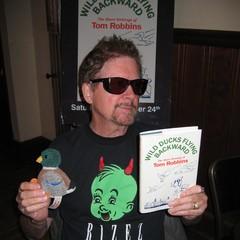
Tom Robbins (born July 22, 1936) is an acclaimed American novelist known for his whimsical, philosophical, and often surreal storytelling. His works blend pop culture, Eastern spirituality, and countercultural themes, with notable titles including 'Another Roadside Attraction' and 'Even Cowgirls Get the Blues'. Born in North Carolina, Robbins worked as a journalist and art critic before turning to fiction. His novels are celebrated for their linguistic playfulness, eccentric characters, and profound meditations on love, freedom, and the human condition. Though not a recipient of major literary prizes, he has cultivated a devoted global readership and influenced generations of writers. He remains a distinctive voice in contemporary American literature. more