Quotessence
Home / Quotes / Quote by Thomas Hobbes

Quote by Thomas Hobbes

Work

Leviathan

Leviathan is a seminal work in political philosophy, examining the relationship between the ruler and the ruled, the nature of government, and the social contract. It argues for the absolute power of the sovereign and the necessity of a strong central authority to maintain order and stability in society. more
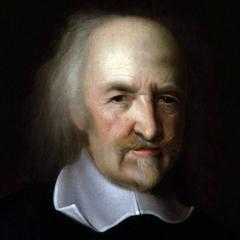
Author

Thomas Hobbes
Thomas Hobbes

Thomas Hobbes, a British philosopher, politician, historian, economist, and writer, was born on April 5, 1588, in Wiltshire, and died on December 4, 1679, in Oxford, England. Hobbes is considered one of the most important philosophers of the 17th century, known for his profound analysis of the state, society, and human behavior. more

You May Also Like

“There is no mission, nor interest to convert, and yet I believe that if this state of consciousness could become more universal, the pretentious nonsense which passes for the serious business of the world would dissolve in laughter. We should see at once that the high ideals for which we are killing and regimenting each other are empty and abstract substiutes for the unheeded miracles that surround us - not only in the obvious wonders of nature but also in the overwhelming uncanny fact of mere existence.”

“It is also in despair of being able to understand or make any productive contribution to the highly organised chaos of our politico-economic system that large numbers of people simply abandon political and social committments. They just let society be taken over by a pattern of organisation which is as self-proliferative as a weed, and whose ends and values are neither human nor instinctive but mechanical.”

“The Chinese word Li may therefore be understood as organic order, as distinct from mechanical or legal order, both of which go by the book. Li is the asymmetrical, nonrepetitive, and unregimented order which we find in the patterns of moving water, the form of trees and clouds, of frost crystals on the window, or the scattering of pebbles on beach sand.”