Quotessence
Home / Quotes / Quote by Judith Butler

Quote by Judith Butler

“What is formed and framed through the technological grasp and circulation of the visual and discursive dimensions of war? This grasping and circulation is already an interpretive manoeuvre, a way of giving an account of whose life is a life, and whose life is effectively transformed into an instrument, a target, or a number, or is affected with only a trace remaining or none at all.”

Quote by Judith Butler

Work

Frames of War: When is Life Grievable?

Browse quotes and source details for this work. more

Author
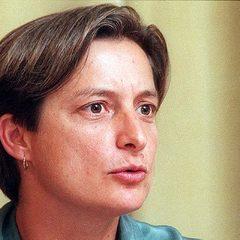
Judith Butler
Judith Butler

Judith Butler is a renowned philosopher, born on February 24, 1956. Her research focuses on issues of gender, identity, and power, having a profound impact on postmodernism and gender theory. more

You May Also Like

“It has been said that no war has been fought without inflation. If we could ever devise a monetary system where inflation was absolutely prohibited, the chance of war breaking out would be greatly reduced. If we had to immediately pay for our foreign entanglements, people would not tolerate paying the bill with higher taxation. It's the meddling in the internal affairs of other nations that brings about the conditions that result in armed conflict. Not initially financing foreign intervention would make us much less likely to get involved in no-win, totally unnecessary wars.”

“The graphics of Israeli life, death, and detention are more vibrant; it conforms to the norm of human life already established, is then more of a life, is life, whereas Palestinian life is either no life, a shadow-life, or a threat to life as we know it. In this last form, it has undergone a full transformation into arsenal or spectral threat, figuring an infinite threat against which a limitless “defense” formulates itself. That defense without limit then embodies the principles of attack without limit (without shame, and without regard for established international protocols regarding war crimes).”

“My grandfather was a voyageur, and lived to be of great age,” recalled “Old” Pierre, “and [he] told me the stories of the wild Indians of those days, and our brave French Canadians who were a match for them. There was a great man of whom he used to speak much, Monsieur de Langlade. […] My grandfather told me that when Langlade was a child about seven years of age, there was a war raging between the Ottawas, many of whom lived at Michilimackinac, and another tribe allied to the English. Twice the young men of the Ottawas had gone forth to attack a village of the enemy, and each time had they been driven back. The French officer at the fort urged them to make the attack again. The Ottawas were not willing. At last, their chief said that he had had a dream; that in the dream he saw a fight; that the young Langlade was there; and that in his dream the Ottawas seemed to win the day. The dream gave the young men courage on its being told them. They must be accompanied by the child Langlade, and they would go upon the war-path once more. The father Langlade, at first unwilling, at last agreed, but only on a pledge given by the boy that he would never disgrace his father by being a coward. The Ottawas were now ready to go forth; they advanced with the terrible war-cries of the [Natives]; inspired by the recollection of the dream and the presence of the boy, they gained the day […]. The young Langlade was now held in great honor; they said he was no doubt preserved by a mighty Manitou [“Great Spirit”].”

“Indeed, so prevalent had his leadership on the battlefield been that day, that Langlade was jointly proclaimed “Ake-wauge-ketausa”, or “Military Conqueror”, by his Indigenous brethren, with the literal translation of his title meaning “He Who is Fierce for the Land”, although an alternative spelling of “Auke-winge-ketaw-so”, meaning “Defender of his Country” is also recorded. However, to the Menomonee (Folles Avoines) specifically, he was simply known henceforth as the “Bravest of the Brave.”