Quotessence
Home / Quotes / Quote by Gerald Edelman

Quote by Gerald Edelman

“Hayek made a quite fruitful suggestion, made contemporaneously by the psychologist Donald Hebb, that whatever kind of encounter the sensory system has with the world, a corresponding event between a particular cell in the brain and some other cell carrying the information from the outside word must result in reinforcement of the connection between those cells. These day, this is known as a Hebbian synapse, but von Hayek quite independently came upon the idea. I think the essence of his analysis still remains with us.”

Quote by Gerald Edelman

Author
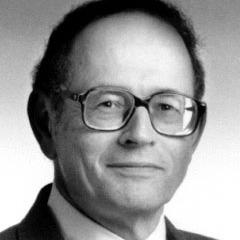
Gerald Edelman
Gerald Edelman

Gerald Edelman was a prominent neuroscientist and immunologist whose research focused on the interaction between the immune system and the brain. His work delved into how the immune system recognizes and attacks foreign substances, and how this process relates to the functioning of the brain. Edelman's research has significant implications for understanding autoimmune diseases and neurodegenerative disorders. more

You May Also Like

“The first proponent of cortical memory networks on a major scale was neither a neuroscientist nor a computer scientist but .. a Viennes economist: Friedrich von Hayek (1899-1992). A man of exceptionally broad knowledge and profound insight into the operation of complex systems, Hayek applied such insight with remarkable success to economics (Nobel Prize, 1974), sociology, political science, jurisprudence, evolutionary theory, psychology, and brain science (Hayek, 1952).”

“Since the idea that modification of synaptic function can provide a basis for memory arose shortly after the first anatomical description of the synapse a number of models (Hebb 1949 . . Hayek 1952 . . Kendel 1981) have been proposed in which various cognitive activities are represented by combinations of the firing patterns of individual neurons.”

“Friedrich Hayek .. seems to have been the first to postulate what is the core of this paper, namely, the idea of memory and perception represented in widely distributed networks of interconnected cortical cells. Subsequently this idea has received theoretical support, however tangential, from the fields of cognitive psychology, connectionism and artificial intelligence. Empirically, it is well supported by the physiological study and neuroimaging of working memory.”