Quotessence
Home / Quotes / Quote by Saint John Chrysostom

Quote by Saint John Chrysostom

Author

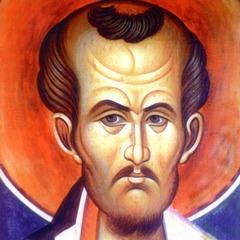
Saint John Chrysostom

Saint John Chrysostom (c. 347 – September 14, 407) was an early Church Father and Archbishop of Constantinople, renowned for his eloquent preaching and oratory, earning the epithet 'Chrysostom' meaning 'golden-mouthed.' Born in Antioch, he received a classical education and later became a hermit. His sermons emphasized moral reform, social justice, and biblical exegesis, often criticizing luxury and corruption. His conflicts with the imperial court and clergy led to multiple exiles, and he died during a forced march. His extensive writings, including homilies, commentaries, and letters, profoundly influenced Eastern Christianity. He is venerated as a saint and Doctor of the Church in Eastern Orthodoxy, Catholicism, and other traditions. more

You May Also Like

“... you... are stones of the temple of the Father, prepared for the Father's building, and drawn up on high by the instrument of Jesus Christ, which is the Cross (cf. Jn. 12:32), making use of the Holy Spirit as a rope, while your faith was the means by which you ascended, and your love the way which led up to God. You, therefore, as well as all your fellow-travelers, are God-bearers, temple-bearers, Christ-bearers, bearers of holiness, adorned in all respects with the commandments of Jesus Christ.”

“... you must hasten to oppose pernicious pride of mind, before it penetrates into the marrow of your bones. Resist it, curb the quickness of your mind and humbly subject your opinion to the opinions of others. Be a fool for the love of God, if you wish to be wiser than Solomon: 'If any man among you seem to be wise in this world, let him become a fool, that he may be wise' (I Cor. 3:18).”

“Do you conceive of your Lord as less because? He shows that humiliation is the best road to exaltation (cf. Mt. 23:12); because He humbles Himself for the sake of the soul that is bent down to the ground, that He may even exalt within Himself that which is bent double under a weight of sin?... If so, you must blame the physician for stooping over suffering and putting up with evil smells in order to give health to the sick?”

“... there is clearly expressed for us? what it is we must attribute either to free will or to the decision and daily assistance of the Lord. We are characterized by whether we respond zealously or lackadaisically to the kindly dispensations of God. This perspective is plainly expressed in the healing of the two blind men. Jesus was passing by, a fact made possible by God's provident grace. And the achievement of their own faith and belief was to cry out 'Lord, son of David, have mercy on us' (Mt. 20:31). The restored sight of their eyes is the gift of divine mercy.”