Quotessence
Home / Quotes / Quote by Ramana Maharshi

Quote by Ramana Maharshi

“If you hold this feeling of ‘I’ long enough and strongly enough, the false ‘I’ will vanish leaving only the unbroken awareness of the real, immanent ‘I’, consciousness itself”

Quote by Ramana Maharshi

Author
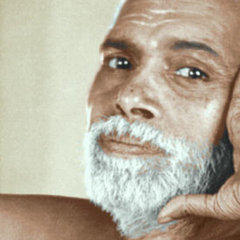
Ramana Maharshi
Ramana Maharshi

Ramana Maharshi, a mystic and philosopher from India, was born on December 30, 1879, and passed away on April 14, 1950. He is considered one of the greatest spiritual teachers of modern India, known for his concise and profound teachings and his inner spiritual experiences. more

You May Also Like

“If one wants to abide in the thought-free state, a struggle is inevitable. One must fight one's way through before regaining one's original primal state. If one succeeds in the fight and reaches the goal, the enemy, namely the thoughts, will all subside in the Self and disappear entirely.”

“Millions of people never analyze themselves. Mentally they are mechanical products of the factory of their environment, preoccupied with breakfast, lunch, and dinner, working and sleeping, and going here and there to be entertained. They don't know what or why they are seeking, nor why they never realize complete happiness and lasting satisfaction. By evading self-analysis, people go on being robots, conditioned by their environment. True self-analysis is the greatest art of progress.”

“The ocean of Spirit has become the little bubble of my soul. Whether floating in birth, or disappearing in death, in the ocean of cosmic awareness the bubble of my life cannot die. I am indestructible consciousness, protected in the bosom of Spirit’s immortality.”

“The reflection, the verisimilitude, of life that shines in the fleshly cells from the soul source is the only cause of man's attachment to his body; obviously he would not pay solicitous homage to a clod of clay. A human being falsely identifies himself with his physical form because the life currents from the soul are breath-conveyed into the flesh with such intense power that man mistakes the effect for a cause, and idolatrously imagines the body to have life of its own.”