Quotessence
Home / Quotes / Quote by John Steinbeck

Quote by John Steinbeck

“Adam seemed clothed in a viscosity that slowed his movements and held his thoughts down. He saw the world through gray water. Now and then his mind fought its way upward, and when the light broke in it brought him only a sickness of the mind, and he retired into the grayness again.”

Quote by John Steinbeck

Work

East of Eden

John Steinbeck's 'East of Eden' is a profound and complex narrative that delves into the lives of the Joad family as they navigate the challenges of their time. The story is rich with symbolism and philosophical musings, offering a rich tapestry of human emotions and societal struggles. more

Author

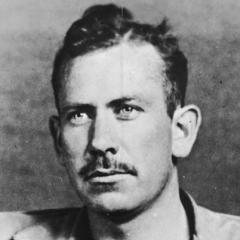
John Steinbeck
John Steinbeck

John Steinbeck was an American author renowned for his profound depiction of American society and the lives of farmers. His works often explore themes of poverty, social injustice, and human nature. Steinbeck was awarded the Nobel Prize in Literature in 1962 for his significant contribution to American literature. more

You May Also Like

“My whole life is behind me. I see it completely, I see its shape and the slow movements which have brought me this far. There is little to say about it: a lost game, that’s all. I had lost the first round. I wanted to play the second and I lost again: I lost the whole game. At the same time, I learned that you always lose. Only the rascals think they win. Now I am going to be like Anny, I am going to outlive myself. Eat, sleep, sleep, eat. Exist slowly, softly, like these trees, like a puddle of water, like the red bench in the streetcar.”

“A man ten times regrets having spoken, for the once he regrets his silence. And why? Because the fact of having spoken is an external fact, which may involve one in annoyances, since it is an actuality. But the fact of having kept silent! Yet this is the most dangerous thing of all. For by keeping silent one is relegated solely to oneself, no actuality comes to a man’s aid by punishing him, by bringing down upon him the consequences of his speech. No, in this respect, to be silent is the easy way. But he who knows what the dreadful is, must for this very reason be most fearful of every fault, of every sin, which takes an inward direction and leaves no outward trace.”