Quotessence
Home / Quotes / Quote by Noam Chomsky

Quote by Noam Chomsky

“One of the Christian fundamentalists' goals seems to be to rebuild the Temple, which means destroying the Al-Aqsa Mosque, which presumably means war with the Arab world - one of the goals, perhaps, in fulfilling the prophecy of Armageddon. So they strongly support Israeli power and expansionism, and help fund it and lobby for it; but they also support actions that are very harmful and objectionable to most of its population - as do Jewish fundamentalist groups, mostly rooted in the US, which, after all, is one of the most extreme religious fundamentalist societies in the world.”

Quote by Noam Chomsky

Author
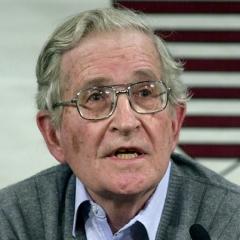
Noam Chomsky
Noam Chomsky

Noam Chomsky, born on December 7, 1928, is a renowned linguist from the United States. His research in generative grammar and transformational grammar has had a profound impact on modern linguistics. Chomsky's academic achievements extend beyond linguistics, as he is also an active political commentator and philosopher, known for his unique perspective and profound insights. more

You May Also Like

“Pakistan will never be able to match the Indian militarily and the effort to do so is taking an immense toll on the society. It's also extremely dangerous with all the weapons development. The two countries have already come close to nuclear confrontation twice and this could get worse. So dealing with the relationship with India is extremely important.”

“American imperialism has suffered a stunning defeat in Indochina. But the same forces are engaged In another war against a much less resilient enemy, the American people. Here, the prospects for success are much greater. The battleground is ideological, not military. At stake are the lessons to be drawn from the American war in Indochina; the outcome will determine the course and character of new imperial ventures.”

“Every book that comes out, every article that comes out, talks about how - while it may have been a "mistake" or an "unwise effort" - the United States was defending South Vietnam from North Vietnamese aggression. And they portray those who opposed the war as apologists for North Vietnam. That's standard to say. The purpose is obvious: to obscure the fact that the United States did attack South Vietnam and the major war was fought against South Vietnam.”

“The real invasion of South Vietnam which was directed largely against the rural society began directly in 1962 after many years of working through mercenaries and client groups. And that fact simply does not exist in official American history. There is no such event in American history as the attack on South Vietnam. That's gone. Of course, It is a part of real history. But it's not a part of official history.”

“Most of us who were opposed to the war, especially in the early '60's - the war we were opposed to was the war on South Vietnam which destroyed South Vietnam's rural society. The South was devastated. But now anyone who opposed this atrocity is regarded as having defended North Vietnam. And that's part of the effort to present the war as if it were a war between South Vietnam and North Vietnam with the United States helping the South. Of course it's fabrication. But it's "official truth" now.”

“The U.S. directed the war against South Vietnam. There was a political settlement in 1954. But in the late '50's the United States organized an internal repression in South Vietnam, not using its troops, but using the local apparatus it was constructing. This was a very significant and very effective campaign of violence and terrorism against the Vietminh - which was the communist-led nationalist force that fought the French. And the Vietminh at that time was adhering to the Geneva Accords, hoping that the political settlement would work out in South Vietnam.”

“From 1962 to 1965 the US was dedicated to try to prevent the independence of South Vietnam, the reason was of course that Kennedy and Johnson knew that if any political solution was permitted in the south, the National Liberation Front would effectively come to power, so strong was its political support in comparison with the political support of the so-called South Vietnamese government.”