Quotessence
Home / Quotes / Quote by Pope Leo XIII

Quote by Pope Leo XIII

“Once the demands of necessity and propriety have been met, the rest that one owns belongs to the poor.”

Quote by Pope Leo XIII

Author
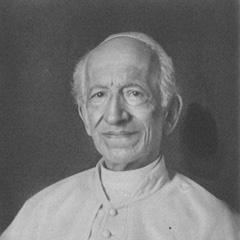
Pope Leo XIII
Pope Leo XIII

Pope Leo XIII (born Vincenzo Gioacchino Raffaele Luigi Pecci) served as the 256th Pope of the Catholic Church from 1878 to 1903, making him one of the longest-reigning popes in history. Born on March 2, 1810, in Carpineto, Italy, he died on July 20, 1903, in Rome. He is renowned for establishing modern Catholic social teaching through his landmark encyclical Rerum Novarum (1891), which addressed workers' rights and became a foundation of Catholic social doctrine. Leo XIII promoted Thomistic philosophy and worked to reconcile the Catholic Church with the modern world. more

You May Also Like

“To refuse any bond of union between man and civil society, on the one hand, and God the Creator and consequently the supreme Law-giver, on the other, is plainly repugnant to the nature, not only of man, but of all created things; for, of necessity, all effects must in some proper way be connected with their cause; and it belongs to the perfection of every nature to contain itself within that sphere and grade which the order of nature has assigned to it, namely, that the lower should be subject and obedient to the higher.”

“These most crafty enemies [the devils] have filled and inebriated with gall and bitterness the Church, the spouse of the Immaculate Lamb, and have laid impious hands on Her most sacred possessions. In the Holy Place itself, where has been set up the See of the most holy Peter and the Chair of Truth for the light of the world, they have raised the throne of their abominable impiety, with the iniquitous design that when the Pastor has been struck, the sheep may be scattered.”

“We have said that the State must not absorb the individual or the family; both should be allowed free and untrammelled action so far as is consistent with the common good and the interest of others. Rulers should, nevertheless, anxiously safeguard the community and all its members; the community, because the conservation thereof is so emphatically the business of the supreme power, that the safety of the commonwealth is not only the first law, but it is a government's whole reason of existence.”

“To the shepherds alone was given all power to teach, to judge, to direct; on the faithful was imposed the duty of following their teaching, of submitting with docility to their judgment, and of allowing themselves to be governed, corrected, and guided by them in the way of salvation. Thus, it is an absolute necessity for the simple faithful to submit in mind and heart to their own pastors, and for the latter to submit with them to the Head and Supreme Pastor.”