Quotessence
Home / Quotes / Quote by Friedrich Nietzsche

Quote by Friedrich Nietzsche

“To be incapable of taking one's enemies, one's accidents, even one's misdeeds seriously for very long—that is the sign of strong, full natures in whom there is an excess of the power to form, to mold, to recuperate and to forget (a good example of this in modem times is Mirabeau, who had no memory for insults and vile actions done him and was unable to forgive simply because he—forgot). Such a man shakes off with a single shrug many vermin that eat deep into others; here alone genuine 'love of one's enemies' is possible—supposing it to be possible at all on earth. How much reverence has a noble man for his enemies!—and such reverence is a bridge to love.—For he desires his enemy for himself, as his mark of distinction; he can endure no other enemy than one in whom there is nothing to despise and very much to honor! In contrast to this, picture 'the enemy' as the man of ressentiment conceives him—and here precisely is his deed, his creation: he has conceived 'the evil enemy,' 'the Evil One,' and this in fact is his basic concept, from which he then evolves, as an afterthought and pendant, a 'good one'—himself!”

Quote by Friedrich Nietzsche

Work

On the Genealogy of Morals / Ecce Homo

Browse quotes and source details for this work. more

Author
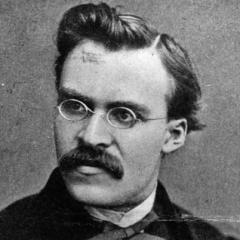
Friedrich Nietzsche
Friedrich Nietzsche

Friedrich Nietzsche was a German philosopher, cultural critic, poet, and writer whose works have had a profound impact on subsequent philosophy, literature, and thought. His ideas revolve around concepts such as the 'will to power', the 'Übermensch', and the 'eternal recurrence'. more

You May Also Like

“Rand, Huxley, Orwell, and Bradbury foresaw much of today’s dystopian world: its spiritual and moral emptiness, its culture of consumerism, its flat-souled Last Manishness, its debasement of language, its doublethink, its illiteracy, and its bovine tolerance of authoritarian indignities. But they did not foresee the most serious and catastrophic of today’s problems: the eminent destruction of whites, and western culture. None of them thought to deal with race at all. Why is this? Probably for the simple reason that it never occurred to any of them that whites might take slave morality so far as to actually will their own destruction. As always, the truth is stranger than fiction.”

“Nietzsche talked about “good and bad” in the context of nobility. The nobles regarded the exceptional as good and the mediocre as bad. When the “good and bad” of the nobility was replaced by the “good and evil” of the mob, exceptionalism was declared evil, and mediocrity was sanctified. The holy mediocrities are now everywhere. The kingdom of mediocrity is absolute … absolute shit!”

“Christmas is about community, collaboration, celebration. Done right, Christmas can be an antidote to the Me First mentality that has rebranded capitalism as neo-liberalism. The shopping mall isn't our true home, nor is it a public space, though, as libraries, parks, playgrounds, museums and sports facilities disappear, for many the fake friendliness of the mall is the only public space left, apart from the streets”

“Feeling in the middle of things, at the place to and from which streets flow, where people come not to escape the city but to be inside it: This us usually what defines a successful square. It is a space around which the rest of a neighborhood or town or city tends to be organized [Michael Kimmelman, "Culture: Power of the Place"].”

“And is it not the artists that make art? Well, no: criticism is now the substance of art making to such a degree that many of today’s public artists do away with the product as an issue, and make public debate the contents of their art. In doing so they are not redefining art so much as redefining public space. The debate itself has become the public space.”

“What do we mean by a public square? For starters, it is rarely square. . . . It may be a quadrangle or rectangle or circle or pretty much any shape, and it can be open or closed. It might even be a park . . . through which people pass, going from one place to another, not simply a retreat. A square is porous, balancing its porousness with some focal point, like a fountain or a reliable patch of sun with some benches that marks a break from the cars and streets and invites people to stop, look, exhale, find one another [Michael Kimmelman, "Part One: Culture: Power of the Place, Introduction"].”