Quotessence
Home / Quotes / Quote by Ralph Waldo Emerson

Quote by Ralph Waldo Emerson

Work

The Essays of Ralph Waldo Emerson

The Essays of Ralph Waldo Emerson is a seminal work in American literature, featuring a series of essays that explore themes of individualism, self-reliance, and the importance of nature. Emerson's essays are known for their lyrical prose and profound influence on the transcendentalist movement. more

Author
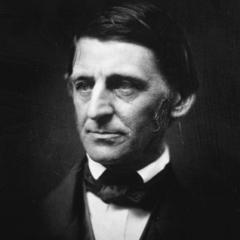
Ralph Waldo Emerson
Ralph Waldo Emerson

American essayist, poet, and philosopher. Born on May 25, 1803, and died on April 27, 1882. Known for his transcendentalist philosophy, his works have had a profound impact on literature and the intellectual world. more

You May Also Like

“We all carry unseen stories under our skin. We hold identities around ethnicity, gender, ability, or religion that remain invisible and are discounted by the world around us. We wish for a sense of belonging without negotiation, explanation, or being required to somehow prove our validity. In a world of separation and division, we need to learn to be better at seeing (and believing) each other.”

“If immigrants ain't real Americans, Neither is our revered Lady Liberty. She too came from a distant land, Yet today she is the American epitome... Though I belong to the whole wide world, Land of Lady Liberty is my home country. A nation's character isn't defined by rigidity, It is defined by a hearty unity in diversity.”

“Enter a hall with high ceiling, and you feel small, in a room with low ceiling you feel like a giant. The height of human doesn't depend on numbers, we judge our height relative to the world around. Bigots hate an inclusive world not because it is unorthodox, but because it reminds them, how puny they are - how small.”

“Integration 101: I don't exist, that's my law of integration. Had I not told you my name, it'd be impossible for you to know my culture and nation. Any ape can boast about its culture, I'll die roaring for all but my own. I am local of a borderblind world, something illegible to the cavegrown. Borders are glorified apartheid, Passports are glorified bus pass. No peace can ever come to light, from the doings of apartheid heart.”

“At the same time that the Mayor and City Council acted courageously and progressively in ridding the city of those monuments to a loathsome past, the new regime that removal celebrates, as some skeptics note, rests on commitments to policies that intensify economic inequality on a scale that makes New Orleans one of the most unequal cities in the United States. ... Local government contributes to this deepening inequality through such means as cuts to the public sector, privatization of public goods and services, and support of upward redistribution through shifting public resources from service provision to subsidy for private, rent-intensifying redevelopment (commonly but too ambiguously called "gentrification"). These processes, often summarized as neoliberalization, do not target blacks as blacks, and, as in other cities, coincided with the emergence of black public officialdom in and after the elder Landrieu's mayoralty and continued unabated through thirty-two years of black-led local government between two Landrieus and into the black-led administration that succeeded Mitch. Both the processes of neoliberalization and racial integration of the city's governing elite accelerated in the aftermath of Hurricane Katrina. It may seem ironic because of how the visual imagery of dispossession and displacement after Katrina came universally to signify the persistence of racial injustice, but a generally unrecognized feature of the post-Katrina political landscape is that the city's governing class is now more seamlessly interracial than ever. That is, or should be, an unsurprising outcome four decades after racial transition in local government and the emergence and consolidation of a strong black political and business class, increasingly well incorporated into the structures of governing. It has been encouraged as well by the city's commitment to cultural and heritage tourism, which, as comes through in Mayor Landrieu's remarks on the monuments, is anchored to a discourse of multiculturalism and diversity. And generational succession has brought to prominence cohorts among black and white elites who increasingly have attended the same schools; lived in the same neighborhoods; participated in the same voluntary associations; and share cultural and consumer tastes, worldviews, and political and economic priorities.”