Quotessence
Home / Quotes / Quote by Swami Vivekananda

Quote by Swami Vivekananda

“You see, no one can teach anybody. The teacher spoils everything by thinking that he is teaching. Thus Vedanta says that within man is all knowledge-even in a boy it is so-and it requires only an awakening, and that much is the work of a teacher.”

Quote by Swami Vivekananda

Work

My Idea of Education

This book delves into the author's vision for education, discussing various methods and theories to enhance learning and personal development. more

Author

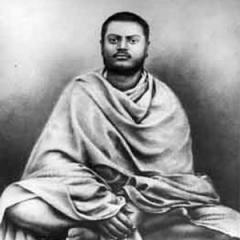
Swami Vivekananda
Swami Vivekananda

Swami Vivekananda (January 12, 1863 – July 4, 1902) was an Indian Hindu monk, philosopher, and social reformer. Born as Narendranath Datta in Kolkata, he was a chief disciple of the mystic Ramakrishna. He is best known for his historic speech at the 1893 Parliament of the World's Religions in Chicago, where he introduced Hinduism to the Western world. He founded the Ramakrishna Mission in 1897, focusing on social service, education, and interfaith harmony. His teachings emphasized self-realization, service to humanity, and the unity of all religions. He wrote extensively on yoga and Vedanta philosophy, influencing global spirituality and Indian nationalism. He died at the age of 39, leaving a lasting legacy as a bridge between Eastern and Western thought. more
You May Also Like

“The foremost or indeed sole condition required in order to succeed in centralizing the supreme power in a democratic community is to love equality or to get men to believe you love it. Thus, the science of despotism, which was once so complex, has been simplified and reduced, as it were, to a single principle.”

“In proportion to the mental energy he spent, the man who creates a new invention receives but a small percentage of his value in terms of material payment, no matter what fortune he makes, no matter what millions he earns. But the man who works as a janitor in the factory producing that invention, receives an enormous payment in proportion to the mental effort that his job requires of him. And the same is true of all men between, on all levels of ambition and ability.”

“The man at the top of the intellectual pyramid contributes the most to all those below him, but gets nothing except his material payment, receiving no intellectual bonus from others to add to the value of his time. The man at the bottom who, left to himself, would starve in his hopeless ineptitude, contributes nothing to those above him, but receives the bonus of all of their brains. Such is the nature of the 'competition' between the strong and the weak of the intellect. Such is the pattern of 'exploitation' for which you have damned the strong.”