Quotessence
Home / Quotes / Quote by Lennox Lewis

Quote by Lennox Lewis

“Sometimes the image of the intellectual boxer did for me more harm than good. If a boxer has a reputation as an intellectual, some people no longer respect him as a fighter. With me it was always ‘Lennox should react, not think’. But that’s nonsense. Only the guy who controls his opponent wins.”

Quote by Lennox Lewis

Author
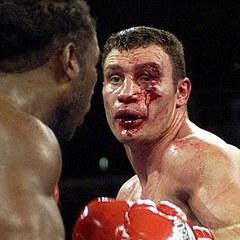
Lennox Lewis
Lennox Lewis

Lennox Lewis, born on September 2, 1965, is a renowned professional boxer from the United Kingdom. He achieved great success in his career, including becoming the world heavyweight boxing champion. Lewis is known for his powerful strength and excellent technique, and is considered one of the greatest boxers in history. more

You May Also Like

“Boxing and chess are similar. It’s about the choice of means. Sometimes I need a pawn, a bishop or a knight to defeat my opponent. It’s about finding the best way. A good boxer has to be variable. He doesn’t just need to know how to punch. He must also know how to protect himself, how to defend, how to avoid the opponent’s punches. Only a complete fighter can become champion.”

“A great champion needs a background in amateur boxing, I’'m convinced of that. There you learn everything that you’ll need later as a pro. Someone who’s got more than 400 amateur fights behind him no longer gets nervous before going into the ring and doesn’t lose his nerve during a fight. You know all the boxing styles, you’re prepared for anything, you’ve got the pedigree that you need to be a successful pro.”

“I could never stand big-mouthed types. I had problems with that at high school. I’ve still got the scars on my fists from the teeth of the guys I hit so that they’d finally shut up. I came from England to Canada, of course, and was often ridiculed because I had a strange accent. I was expelled from school and it was a long time before I could control myself. But the impulse remained: a punch in the mouth to get some peace and quiet.”

“Patience is a part of boxing. After I had missed out on the Olympic gold medal in 1984, a lot of people tried to talk me into turning professional quickly to make money. They told me that the next Olympics in Seoul would be boycotted again, that I was wasting my life, blah blah. But I still had unfinished business. I wanted the gold medal, and I got it in ‘88. Only then was I ready to turn professional.”

“Recently I donated money to the establishment of the Muhammad Ali Foundation in Louisville. I regard that as a kind of payback. He smoothed the way for us. He wasn’t just a great person who had conviction, but made the sport of boxing great. He was the first superstar, he made our stock rise. Without him we wouldn’t have earned so much. Americans from every walk of life have contributed to the foundation: Bill Clinton, Angelina Jolie, Brad Pitt. Unfortunately I was the only American athlete to make a donation. There’s not enough respect in our business.”

“At first I didn’t give a damn to go down in history. I wanted to win. But the more I won, the more I thought about leaving something behind. Yes, it's as important as hell to me. I want to leave something that people will remember me by. Of course, a lot of boxers want to do that. But it's not easy. Take Larry Holmes, he was the big man after Muhammad Ali, he wanted to emulate him, but for some reason the public didn’t take him like they did to Ali. I think people won’t fully understand what I contributed to the sport for years.”