Quotessence
Home / Quotes / Quote by Nicholas Kurti

Quote by Nicholas Kurti

“I think it is a sad reflection on our civilization that while we can and do measure the temperature in the atmosphere of Venus we do not know what goes on inside our soufflés.”

Quote by Nicholas Kurti

Author
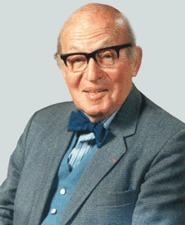
Nicholas Kurti
Nicholas Kurti

Nicholas Kurti, born on May 14, 1908 in Hungary and died on November 24, 1998, was a renowned physicist. He made significant contributions to quantum mechanics and condensed matter physics, particularly in the study of superconductivity, where he made breakthroughs that led to the formulation of the Kurti-Meissner effect. more

You May Also Like

“I would like to emphasize strongly my belief that the era of computing chemists, when hundreds if not thousands of chemists will go to the computing machine instead of the laboratory for increasingly many facets of chemical information, is already at hand. There is only one obstacle, namely that someone must pay for the computing time.”

“Imagine a school-boy who has outgrown his clothes. Imagine the repairs made on the vestments where the enlarged frame had burst the narrow limits of its inclosure. Imagine the additions made where the projecting limbs had fairly and far emerged beyond the confines of the garment. Imagine the boy still growing, and the clothes, mended all over, now more than ever in want of mending - such is chemistry, and such its nomenclature.”

“On the terrace of the Pepiniere, the 150 pupils of the Institut Chemique talk chemistry as they leave the auditoria and the laboratory. The echoes of the magnificent public garden of the city of Nancy make the words reverberate; coupling, condensation, grignardization. Moreover, their clothes stay impregnated with strong and characteristic odours; we follow the initiates of Hermes by their scent. In such an environment, how is it possible not to be productive?”

“The advances of biology during the past 20 years have been breathtaking, particularly in cracking the mystery of heredity. Nevertheless, the greatest and most difficult problems still lie ahead. The discoveries of the 1970's about the chemical roots of memory in nerve cells or the basis of learning, about the complex behavior of man and animals, the nature of growth, development, disease and aging will be at least as fundamental and spectacular as those of the recent past.”