Quotessence
Home / Quotes / Quote by Martin Luther King, Jr.

Quote by Martin Luther King, Jr.

“Non-violent direct action seeks to create such a crisis and establish such creative tension that a community that has constantly refused to negotiate is forced to confront the issue. It seeks so to dramatize the issue that it can no longer be ignored... I am not afraid of the word tension. I have earnestly worked and preached against violent tension, and there is a type of constructive tension that is necessary for growth.”

Quote by Martin Luther King, Jr.

Work

The Essential Martin Luther King, Jr.:

This book compiles a selection of Martin Luther King, Jr.'s influential speeches and essays, highlighting his advocacy for civil rights, non-violence, and equality. It includes key addresses such as 'I Have a Dream' and 'Letter from Birmingham Jail', offering insight into his leadership and the social and political context of his time. more

Author
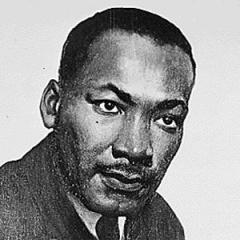
Martin Luther King, Jr.

Martin Luther King Jr. was an American civil rights activist known for his nonviolent protest and advocacy for equal rights. His 'I Have a Dream' speech at the Lincoln Memorial in 1963 became a significant milestone in the American civil rights movement. more

You May Also Like

“Just as one must learn the art of killing in the training for violence, so one must learn the art of dying in the training for non-violence. Violence does not mean the emancipation from fear, but discovering the means of combating the cause of fear. Nonviolence, on the other hand, has no cause for fear. The votary of nonviolence has to cultivate the capacity for sacrifice of the highest type in order to be free from fear. He recks not if he should lose his land, his wealth, his life.”

“In the event of a violent revolution, we would be sorely outnumbered. And when it was all over, the Negro would face the same unchanged conditions, the same squalor and deprivation-the only difference being that his bitterness would be even more intense, his disenchantment even more abject. Thus, in purely practical as well as moral terms, the American Negro has no rational alternative to nonviolence.”

“I would be misleading you if I made you feel that we could win a violent campaign. It's impractical even to think about it. The minute we start, we will end up getting many more people killed unnecessarily. Now, I'm ready to die myself. Many other committed people are ready to die. If you believe in something firmly, if you believe in it truly, if you believe it in your heart, you are willing to die for it, but I'm not going to advocate a method that brings about unnecessary death.”

“It is the best thing to blame ourselves when people cannot get on well with us. Boundless charity necessarily includes all or it ceases to be boundless. We must be strict with ourselves and lenient with our neighbors. For we know not their difficulties and what they overcome.”

“The Negro who experiences bitter and agonizing circumstances as a result of some ungodly white person is tempted to look upon all white persons as evil, if he fails to look beyond his circumstances. But the minute he looks beyond his circumstances and sees the whole of the situation, he discovers that some of the most implacable and vehement advocates of racial equality are consecrated white persons.”