“We shall try to spirit the penniless population across the border by procuring employment for it in the transit countries, while denying it any employment in our own country .... expropriation and the removal of the poor must be carried out discreetly and circumspectly.”
Quote by Theodor Herzl
Work
The Jews' State: A Critical English Translation
This volume offers an English rendering of Der Judenstaat, the pamphlet in which Austrian journalist Theodor Herzl articulated the case for a modern Jewish state. The critical translation approach typically involves careful examination of Herzl's original German prose, attention to terminological choices that shape political meaning, and contextual notes that illuminate the work's historical circumstances. The text remains a pivotal document in modern Jewish political thought, outlining practical proposals for Jewish settlement and statehood in response to European antisemitism. Critical editions generally include introductory material addressing Herzl's intellectual formation, the pamphlet's composition and initial reception, and its subsequent influence on Zionist movement development. The translation itself aims to balance fidelity to Herzl's rhetorical style with accessibility for contemporary readers, often highlighting passages where interpretive decisions carry significant implications for understanding Herzl's vision. more
Author
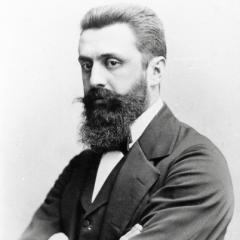
Theodor Herzl
Theodor Herzl (May 2, 1860 – July 3, 1904) was an Austrian journalist and playwright, recognized as the founder of modern political Zionism. His novel 'The Jewish State' outlined his vision for a Jewish homeland in Palestine, which became the basis for the establishment of the State of Israel. more
You May Also Like
“"We seem to have thought of everything - except the Arabs"”
“If this be the Messiah, then I do not wish to see his coming”
Source: The World as Will and Representation
Source: A Primer in Positive Psychology
Source: Working with Emotional Intelligence