Quotessence
Home / Quotes / Quote by Aristotle

Quote by Aristotle

Work

The Essential Aristotle

This compilation brings together essential writings of Aristotle, offering readers a concise yet profound understanding of his intellectual legacy. It includes extracts from his major treatises, providing a glimpse into his logical reasoning, empirical observations, and philosophical theories that have influenced Western thought for centuries. more

Author
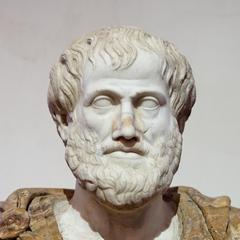
Aristotle
Aristotle

Aristotle, a renowned Greek philosopher, is one of the founders of Western philosophy. His thoughts covered a wide range of fields, including ethics, logic, politics, and had a profound impact on the world. more

You May Also Like

“The laws are, and ought to be, relative to the constitution, and not the constitution to the laws. A constitution is the organization of offices in a state, and determines what is to be the governing body, and what is the end of each community. But laws are not to be confounded with the principles of the constitution; they are the rules according to which the magistrates should administer the state, and proceed against offenders.”

“If what was said in the Ethics is true, that the happy life is the life according to virtue lived without impediment, and that virtue is a mean, then the life which is in a mean, and in a mean attainable by every one, must be the best. And the same principles of virtue and vice are characteristic of cities and of constitutions; for the constitution is in a figure the life of the city.”

“In the first place, then, men should guard against the beginning of change, and in the second place they should not rely upon the political devices of which I have already spoken invented only to deceive the people, for they are proved by experience to be useless.”

“That which most contributes to the permanence of constitutions is the adaptation of education to the form of government, and yet in our own day this principle is universally neglected. The best laws, though sanctioned by every citizen of the state, will be of no avail unless the young are trained by habit and education in the spirit of the constitution.”

“The form of government is a democracy when the free, who are also poor and the majority, govern, and an oligarchy when the rich and the noble govern, they being at the same time few in number.”

“Democracy appears to be safer and less liable to revolution than oligarchy. For in oligarchies there is the double danger of the oligarchs falling out among themselves and also with the people; but in democracies there is only the danger of a quarrel with the oligarchs. No dissension worth mentioning arises among the people themselves. And we may further remark that a government which is composed of the middle class more nearly approximates to democracy than to oligarchy, and is the safest of the imperfect forms of government.”

“There is an error common to both oligarchies and to democracies: in the latter the demagogues, when the multitude are above the law, are always cutting the city in two by quarrels with the rich, whereas they should always profess to be maintaining their cause; just as in oligarchies the oligarchs should profess to maintain the cause of the people, . .”