Quotessence
Home / Quotes / Quote by Padma Lakshmi

Quote by Padma Lakshmi

“But because divorce was so unheard of in middle-class Indian society, people looked at divorcées with a sort of incredulous shock and wonder, as if they were somehow criminals. They were ostracized from everyday life because of an invisible scarlet D hovering over them. Meanwhile, Second Wave feminism in the United States was changing attitudes about how women were treated in the workplace and in society, and how unmarried women were perceived in particular. Women were challenging age-old notions of their place in the world. Western media was full of unafraid, smart American women who published magazines, were marching in DC, and were generally making a lot of noise. No such phenomenon had reached our Indian shores. I’m sure my mother had read about the ERA movement, Roe v. Wade, and bra burnings. She, too, wanted the freedom to earn a living in a country where she wouldn’t be a pariah because of her marital status. We could have a fighting chance at surviving independently in the United States, versus being dependent on her father or a future husband in India. Conservative as he was, my grandfather K. C. Krishnamurti, or “Tha-Tha,” as I called him in Tamil, had encouraged her to leave my father after he witnessed how she had been treated. He respected women and loved his daughter and it must have broken his heart to see the situation she had married into. He, too, wanted us to have a second chance at happiness. America, devoid of an obvious caste system and outright misogyny, seemed to value hard work and the use of one’s mind; even a woman could succeed there. My grandfather was a closet feminist.”

Quote by Padma Lakshmi

Work

Love, Loss, and What We Ate: A Memoir

Browse quotes and source details for this work. more

Author
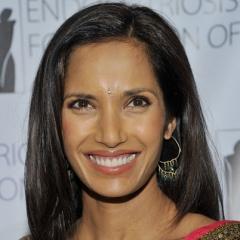
Padma Lakshmi
Padma Lakshmi

Padma Lakshmi is an Indian-American author and television personality. Born on September 1, 1970, she is best known for her hosting role on the popular food show 'Top Chef'. Lakshmi has also published several books on cooking and life, and has made significant contributions to the culinary and fashion industries with her unique background and talents. more

You May Also Like

“Because whites are not socialized to see ourselves collectively, we don't see our group's history as relevant. Therefore, we expect people of color to trust us as soon as they meet us. We don't see ourselves as having to earn that trust.”

“Racism is a philosophy based on a contempt for life. It is the arrogant assertion that one race is the center of value and object of devotion, before which other races must kneel in submission. It is the absurd dogma that one race is responsible for all the progress of history and alone can assure the progress of the future. Racism is total estrangement. It separates not only bodies, but minds and spirits. Inevitably it descends to inflicting spiritual or physical homicide upon the out-group.”

“I was 18 wen I started driving I was 18 the first time I was pulled over. It was 2 AM on a Saturday The officer spilled his lights all over my rearview mirror, he splashed out of the car with his hand already on his weapon, and looked at me the way a tsunami looks at a beach house. Immediately, I could tell he was the kind of man who brings a gun to a food fight. He called me son and I thought to myself, that's an interesting way of pronouncing "boy," He asks for my license and registration, wants to know what I'm doing in this nieghborhood, if the car is stolen, if I have any drugs and most days, I know how to grab my voice by the handle and swing it like a hammer. But instead, I picked it up like a shard of glass. Scared of what might happen if I didn't hold it carefully because I know that this much melanin and that uniform is a plotline to a film that can easily end with a chalk outline baptism, me trying to make a body bag look stylish for the camera and becoming the newest coat in a closet full of RIP hashtags. Once, a friend of a friend asked me why there aren't more black people in the X Games and I said, "You don't get it." Being black is one of the most extreme sports in America. We don't need to invent new ways of risking our lives because the old ones have been working for decades. Jim Crow may have left the nest, but our streets are still covered with its feathers. Being black in America is knowing there's a thin line between a traffic stop and the cemetery, it's the way my body tenses up when I hear a police siren in a song, it's the quiver in my stomach when a cop car is behind me, it's the sigh of relief when I turn right and he doesn't. I don't need to go volcano surfing. Hell, I have an adrenaline rush every time an officer drives right past without pulling me over and I realize I'm going to make it home safe. This time.”

“In principle, it was easy to support the civil rights movement in Mississippi or Washington or on the streets of Detroit. Of course, it was right. But feeling- now, there's a war zone full of land mines which could blow to smithereens any right-thinking individual. And that of course is the territory of race.”

“Lynchings in the past have significantly shaped race relations in the present. A killing such as George Floyd’s lands on black people with a much heavier psychological weight because of lynching’s legacy. Too many white people fail to recognize this, and that needs to change. The hurt is too great, the simmering fear and anger too volatile, to bury forever. All Americans who would seek or demand a nation that is fairer to every citizen, less racist, and more peaceful have a responsibility to know this history in detail. … Confronting this ugliness would be difficult for everyone, of course, but it should be attempted. Ignorance and denial certainly have not worked, because this American wound still bleeds.” -- “Why White America Must Learn the History of Lynching”, Skeptical Inquirer (December 2020)”