Quotessence
Home / Quotes / Quote by Aleksandr Solzhenitsyn

Quote by Aleksandr Solzhenitsyn

“Where did this wolf-tribe appear from among our people? Does it really stem from our own roots? Our own blood? It is our own. And just so we don't go around flaunting too proudly the white mantle of the just, let everyone ask himself: "If my life had turned out differently, might I myself not have become just such an executioner?" It is a dreadful question if one really answers it honestly.”

Quote by Aleksandr Solzhenitsyn

Work

The Gulag Archipelago

Browse quotes and source details for this work. more

Author
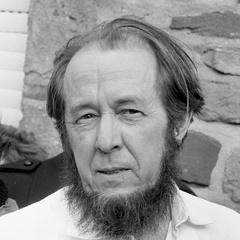
Aleksandr Solzhenitsyn

Aleksandr Solzhenitsyn, a Russian novelist, was born on December 11, 1918, and died on August 3, 2008. He is renowned for his works that profoundly exposed the dark side of the Soviet political system and is considered one of the greatest writers of the 20th century. more

You May Also Like

“Russians love a good plot--camarillas, Masons, whatever--where in fact there is usually just plain sloppiness. Someone mistrusted someone else; someone failed to warn someone else. So someone decided to take out more insurance, called up the troops and removed the tsar from Petersburg. Great and terrible events in Russia are usually due to someone's stupidity or laziness.”

“July is a bad month for revolutionaries. In France, Robespierre was executed in July; in Russia, five eminent Decembrists, who had revolted against Nicholas I, were hanged in July. And now in July the hour of vengeance had come. Vengeance against the son and grandson of the man who had once killed Lenin's brother. The revolutionaries' age-old hunt for Russian tsars was drawing to a close.”

“On the ninth anniversary celebration of the Moncada Barracks Attack, Castro gave a speech in Santiago stating that the only thing Cuba had to fear was a direct attack by the United States. At the same time, the Russians were off-loading men and equipment from ships at the small, hardly-noticed port of Mariel. They transported their equipment, mostly at night, into a thickly wooded area in the mountains near San Cristóbal, which was 26 miles away from the port and approximately 50 miles from Havana. The CIA received a report that a twenty-six foot missile had been seen being transported on Cuban Highway A 1. This was twice the size of a SAM missile and the CIA deemed it highly unlikely that the Soviet Union would send offensive weapons of this size to Cuba. However, with the cold war in high gear, Khrushchev thought that he could change the balance of power between the United States and the Soviet Union by placing missiles on Cuban soil. This operation was conducted in strict secrecy, with Castro reluctantly agreeing to it. Castro still felt that Cuba’s alliance with the Soviet’s was risky and that this was a negative compromise undermining Cuban autonomy. Their secret however became confirmed by an Air Force U 2 surveillance aircraft, sent on a reconnaissance mission, dispatched over the western part of the island. The United States and the Soviet Union agreed on a deal. In return for pulling the Russian missiles out of Cuba the U.S. agreed to pull its missiles out of Turkey.”

“Lucitta knew Russian politics, and discussed how Trotsky was compelled by Stalin’s régime to deny many of his beliefs. It seemed that Mella, believing in one’s own personal independence, developed an interest in Trotsky’s philosophy. Basically, Trotsky believed that an international revolution should be initiated by the people, and that Communism wouldn’t succeed if it were only in one country surrounded by capitalistic states. Stalin countered that Marxism should be concentrated and strengthened under strong leadership in one country, which was the case in Russia. It didn’t help Trotsky’s cause within the Communist Party, when he contended that Stalinism in reality was “Tyranny disguised as Communism.”

“Russia, after all, has existed for a thousand years; the Soviet era lasted only seventy-four. The Romanov dynasty, which included such towering figures as Peter and Catherine the Great, had ruled for more than three centuries. It came to an end in brutal murders in a Siberian cellar, but many Russians never knew this had happened. Or how. Or why.”