Quotessence
Home / Quotes / Quote by William Shakespeare

Quote by William Shakespeare

Work

Antony and Cleopatra

William Shakespeare's Antony and Cleopatra is a tragedy that delves into the lives of the eponymous characters, Mark Antony and Cleopatra, and their tumultuous affair amidst the political backdrop of ancient Egypt and Rome. The play examines themes of love, power, and betrayal, and is renowned for its vivid portrayal of the characters and its poetic language. more
Author

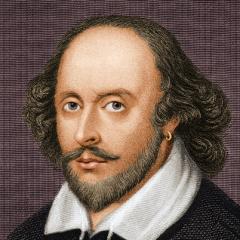
William Shakespeare
William Shakespeare

William Shakespeare (1564 - April 23, 1616) was one of the greatest poets of the English Renaissance, renowned for his dramatic works. His plays spanned a variety of genres, including tragedy, comedy, and history, and have had a profound impact on literature worldwide. more

You May Also Like

“That freedom, the plunging back into the ancient past, appears always to have heightened his alienation from the present. To sure his love for classical Latin didn't lead him to idealize, as some of his contemporaries did Ancient Roman history, Poggio understand that history had it's full measure of full folly and wickedness. But he was aware that the city in which he lived was a pathetic shadow of it's past glory.”

“When we walk in the flesh, we try to win arguments with words, change people with pressure, and fight spiritual battles with carnal methods. But the kingdom of God operates differently. We can't silence demons and their agents with our temper or logic. Instead, we walk in the Spirit, relying on God's power and wisdom. In the Spirit, we speak with authority, not aggression, and trust in God's sovereignty. It's in the stillness and quiet confidence of the Spirit that we find true power and victory.”

“The Western Empire, supported generation after generation by half a hundred of the strongest and most remarkable men in history, from Stilicho to Charlemagne, died and disintegrated and left off being the Empire. The Eastern Empire, supported by fools and slaves and fops, and ruled by the worst and most incompetent of men and women, managed to endure and thrive for a thousand years more.”

“The Goths had trained bears and possibly, from one garbled account, trained seals. The dance is something with no survival, lacking verbal or pictorial record. The Goths may have had it. If they painted, it was not in a medium or on a material that has survived. Their history was unwritten. Their scientific speculation may not have gone beyond mead-table discussions and arguments. There is no record of their early philosophy. Since they were Germans, they must have constructed philosophical systems; and also, since they were Germans, these would have been erroneous.”

“Stilicho first talked of himself; and then of the Empire, which was an extension of himself. He gave it as his studied and honest opinion that he was the best horseman in the world, the best archer and targeteer, the best lancer, and that he had been the best swordsman; one cannot remain the best with the sword without spending six to eight hours a day in the practice of it. Stilicho attested that he was the greatest foot soldier alive, being able to cover afoot seventy Roman miles over rough country between midnight and midnight under the full weight of arms and provisions—about a hundred pounds in modern weight. Stilicho could endure hunger and thirst and privation beyond all others; he could plan and project more than could another man; he could hold every detail of a countryside in his head, and could recall the underfoot stones of a night path a dozen years later. He could see the pattern of affairs and the pattern behind the pattern. Stilicho spoke of himself without vainglory, and certainly without modesty. He acknowledged that it was unusual for one man so to excel in everything; but was happy that that one person should be such a responsible person as himself. He gave the opinion that even in himself it would be a short-term affair. Soon his hand and his mind would weaken a little, and soon another man—probably one of them—would move into his place. A dozen years, he told them, is an extreme limit of the time in which a man may serve faultlessly”

“Several bitter contemporary references to the pseudo-Emperor Eugenius had puzzled us. They asked how a man of such an appearance could attempt the pagan re-establishment. They asked it in horror, for there were certain horrifying aspects to this particular pagan reversion. It was not the old disinterested paganism; it was impassioned and very nearly diabolical in some of its manifestations. The meaning of the references came clear with the examination of reproductions of coins and medallions of the pseudo-Emperor. Eugenius, who affected an old oriental style in hair and beard, had the face of Jesus Christ.”

“Rufinus was an orator and a lawyer, a master of civil administration and agenda. It was because of him that the Eastern Empire—Byzantium—became a bureaucracy for a thousand years; and lived on because its administration had become too intricate to die—though there are those who say that its death was concealed in a sea of paper for that one thousand years. The heritage of Rufinus was the first and longest-enduring paper Empire. It is not accidental that in the tenure of Rufinus as Master of Offices, the duplication of written copies was first brought about. This was not on the order of carbon paper used at the instant of writing; it was wet-process copies made from a finished piece. The process is a detail, however; in the true sense Rufinus was the inventor of carbon copies. Shorthand was then five hundred years old, but Rufinus was the inventor of an improved form of shorthand. It is believed that certain clerks of his appointing are still shuffling papers at the same desks. The paper world he set up was self-perpetuating.”