Quotessence
Home / Quotes / Quote by Georg Wilhelm Friedrich Hegel

Quote by Georg Wilhelm Friedrich Hegel

Work

Aesthetics: Lectures on Fine Art

This book delves into the philosophical and theoretical aspects of fine art, examining the concepts and principles that shape the appreciation and creation of art. more

Author
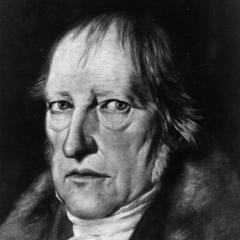
Georg Wilhelm Friedrich Hegel

German philosopher, one of the most important representatives of German classical philosophy. Hegel's philosophical system has had a profound impact on the world. Hegel believed that the task of philosophy is to reveal the absolute spirit, emphasizing the importance of reason, history, and dialectics. more

You May Also Like

“Because of its concrete content, sense-certainty immediately appears as the richest kind of knowledge, indeed a knowledge of infinite wealth for which no bounds can be found, either when we reach out into space and time in which it is dispersed, or when we take a bit of this wealth, and by division enter into it. Moreover, sense-certainty appears to be the truest knowledge ... but, in the event, this very certainty proves itself to be the most abstract and poorest truth. All that it says about what it knows is just that it is; and its truth contains nothing but the sheer being of the thing.”

“Each of the parts of philosophy is a philosophical whole, a circle rounded and complete in itself. In each of these parts, however, the philosophical Idea is found in a particular specificality or medium. The single circle, because it is a real totality, bursts through the limits imposed by its special medium, and gives rise to a wider circle. The whole of philosophy in this way resembles a circle of circles. The Idea appears in each single circle, but, at the same time, the whole Idea is constituted by the system of these peculiar phases, and each is a necessary member of the organisation.”

“Every philosophy is complete in itself and, like a genuine work of art, contains the totality. Just as the works of Apelles and Sophocles, if Raphael and Shakespeare had known them, should not have appeared to them as mere preliminary exercises for their own work, but rather as a kindred force of the spirit, so, too reason cannot find in its own earlier forms mere useful preliminary exercises for itself.”