Quotessence
Home / Quotes / Quote by Karl Popper

Quote by Karl Popper

“I don't know whether God exists or not. ... Some forms of atheism are arrogant and ignorant and should be rejected, but agnosticism—to admit that we don't know and to search—is all right. ... When I look at what I call the gift of life, I feel a gratitude which is in tune with some religious ideas of God. However, the moment I even speak of it, I am embarrassed that I may do something wrong to God in talking about God.”

Quote by Karl Popper

Author
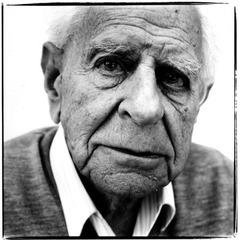
Karl Popper
Karl Popper

Karl Popper (July 28, 1902 – September 17, 1994) was an influential philosopher known for his work on critical rationalism and falsificationism. He is renowned for his contributions to the philosophy of science, political philosophy, and epistemology, with his ideas having a profound impact on these fields. more

You May Also Like

“The true Enlightenment thinker, the true rationalist, never wants to talk anyone into anything. No, he does not even want to convince; all the time he is aware that he may be wrong. Above all, he values the intellectual independence of others too highly to want to convince them in important matters. He would much rather invite contradiction, preferably in the form of rational and disciplined criticism. He seeks not to convince but to arouse - to challenge others to form free opinions.”

“Every intellectual has a very special responsibility. He has the privilege and the opportunity of studying. In return, he owes it to his fellow men (or 'to society') to represent the results of his study as simply, clearly and modestly as he can. The worst thing that intellectuals can do - the cardinal sin - is to try to set themselves up as great prophets vis-à-vis their fellow men and to impress them with puzzling philosophies. Anyone who cannot speak simply and clearly should say nothing and continue to work until he can do so.”

“Astrologers were greatly impressed, and misled, by what they believed to be confirming evidence-so much so that they were quite unimpressed by any unfavorable evidence. Moreover, by making their interpretations and prophecies sufficiently vague they were able to explain away anything that might have been a refutation of the theory had the theory and the prophecies been more precise. In order to escape falsification they destroyed the testability of their theory. It is a typical soothsayer's trick to predict things so vaguely that the predictions can hardly fail: that they become irrefutable.”