Quotessence
Home / Quotes / Quote by Christopher Paolini

Quote by Christopher Paolini

Work

Inheritance

Inheritance is a fictional narrative that delves into the complex dynamics of a family's inheritance, examining the impact of wealth and power on individual lives and relationships. more
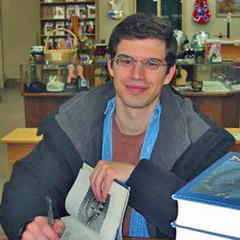
Author

Christopher Paolini
Christopher Paolini

Christopher Paolini is an American author who gained fame with his fantasy novel series, 'The Inheritance Cycle'. Born on November 17, 1983, he began his writing career in his teenage years and quickly gained a wide readership. more

You May Also Like

“Or how does it happen that trade, which after all is nothing more than the exchange of products of various individuals and countries, rules the whole world through the relation of supply and demand—a relation which, as an English economist says, hovers over the earth like the fate of the ancients, and with invisible hand allots fortune and misfortune to men, sets up empires and overthrows empires, causes nations to rise and to disappear—while with the abolition of the basis of private property, with the communistic regulation of production (and implicit in this, the destruction of the alien relation between men and what they themselves produce), the power of the relation of supply and demand is dissolved into nothing, and men get exchange, production, the mode of their mutual relation, under their own control again?”

“Maybe she hated being out of control, knowing that someone or something else was dictating her fate. Because it's really not fair. A drunk driver runs a red light, and you end up dead. A guy in a movie theater coughs on you, and you catch some rare, fatal disease. You sit in class minding your own business, and there's the kid from sixth period holding a gun in his hand. Why should other people be in control? Why should someone else get to choose when you die?”

“Everyone," Ross said, "seems a little less concerned than I do. Am I more tender-hearted for others or only tender because of my own conscience?" "We are not–untender," she said. "Not so. But maybe we are more–resigned. When a man is condemned to death we accept it, though it's sad to do so. We know we cannot change it. You hoped to change it–so it's more of a–a disappointment. You feel you have failed. We don't feel that because we never hoped to succeed.”