Quotessence
Home / Quotes / Quote by Baron de Montesquieu

Quote by Baron de Montesquieu

Work

The Spirit of Laws

Written by Charles de Secondat, Baron de Montesquieu, this seminal work explores the relationship between law, political institutions, and social order. It delves into the principles of separation of powers and the impact of climate and geography on the formation of laws and governments. more
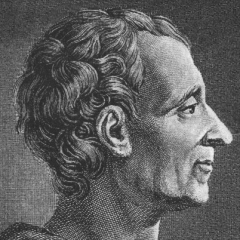
Author

Baron de Montesquieu

Baron de Montesquieu, a French Enlightenment thinker, jurist, historian, and politician, was born on January 18, 1689, and died on February 10, 1755. He is one of the most important thinkers in the history of Western political thought, known for his contributions to the theory of the separation of powers. more

You May Also Like

“The spirit of commerce is frugality, economy, moderation, labor, ponderance, tranquillity, order, and rule. So long as this spirit subsides, the riches it produces have no bad effect. The mischief is when excessive wealth destroys the spirit of commerce, then it is that the conveniences of inequality... are felt.”

“You cannot raise the standard against oppression, or leap into the breach to relieve injustice, and still keep an open mind to every disconcerting fact, or an open ear to the cold voice of doubt. I am satisfied that a scholar who tries to combine these parts sells his birthright for a mess of pottage; that, when the final count is made, it will be found that the impairment of his powers far outweighs any possible contribution to the causes he has espoused.”

“The Idea of Anti-imperialism is... to be considered on several grounds. First, it is traditionally pervasive in the United States, though given its most extreme form in anti-Western academe. Second, it is used as a negative label for any effort by the United States, or the West, to encourage liberties, to block fanaticisms, and to make aid dependent on positive economic policies. Those concerned with the future development of their countries, and of the world, cannot afford to let obsolete resentments distort their aims.”

“The bureaucratic manager, the consuming aesthete, the therapist, the protester and their numerous kindred occupy almost all the available culturally recognizable roles, the notions of the expertise of the few and of the moral agency of everyone are the presuppositions of the dramas which those characters enact. To cry out that the emperor had no clothes on was at least to pick on one man only to the amusement of everyone else; to declare that almost everyone is dressed in rags is much less likely to be popular.”

“Electronic brains may help us to use our heads but will not excuse us from that duty, and as to our hearts-cardiograms cannot diagnose what may be most ill about them, or confirm what may be best. The faithful woman and the versatile brave man, the wakeful intelligence open to inspiration or grace-these are still exemplary for our kind, as they always were and always will be.”

“It is marriage, perhaps, which had given man the best of his freedom, given him his little kingdom of his own within the big kingdom of the state.... It is a true freedom because it is a true fulfilment, for man, woman and children. Do we then want to break marriage? If we do break it, it means we all fall to a far greater extent under the direct sway of the State.”