Quotessence
Home / Quotes / Quote by Celia Thaxter

Quote by Celia Thaxter

“O brief, bright smile of summer! O days divine and dear The voices of winter's sorrow Already we can hear. And we know that the frosts will find us, And the smiling skies grow rude, While we look in the face of Beauty, And worship her every mood.”

Quote by Celia Thaxter

Author
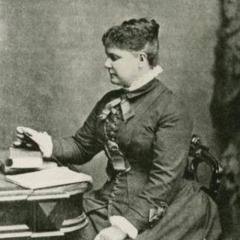
Celia Thaxter
Celia Thaxter

Celia Thaxter was an American writer known for her poetry and prose. Born on June 29, 1835, in Portsmouth, New Hampshire, she spent much of her life on the Isles of Shoals, a group of islands off the coast of Maine. Her work often reflected her close connection to nature and her experiences in the islands. Thaxter's writing career began with her poetry, which was published in various magazines and journals. She later expanded her repertoire to include novels and short stories. Her most famous work is 'The Gables,' a novel that offers a vivid portrayal of island life. Thaxter passed away on August 25, 1894. more

You May Also Like

“The death of God left the angels in a strange position. They were overtaken suddenly by a fundamental question. One can attempt to imagine the moment. How did they look at the instant the question invaded them, flooding the angelic consciousness, taking hold with terrifying force? The question was, "What are angels?" New to questioning, unaccustomed to terror, unskilled in aloneness, the angels (we assume) fell into despair.”

“What an artist does, is fail. Any reading of the literature, (I mean the literature of artistic creation), however summary, will persuade you instantly that the paradigmatic artistic experience is that of failure. The actualization fails to meet, equal, the intuition. There is something "out there" which cannot be brought "here". This is standard. I don't mean bad artists, I mean good artists. There is no such thing as a "successful artist" (except, of course, in worldly terms).”

“The question so often asked of modern painting, "What is it?", contains more than the dull skepticism of the man who is not going to have the wool pulled over his eyes. It speaks of a fundamental placement in relation to the work, that of a voyager in the world coming upon a strange object. The reader reconstitutes the work by his active participation, by approaching the object, tapping it, shaking it, holding it to his ear to hear the roaring within. It is characteristic of the object that it does not declare itself all at once, in a rush of pleasant naïveté.”