Quotessence
Home / Quotes / Quote by Allen C. Guelzo

Quote by Allen C. Guelzo

“Abraham Lincoln did speak about keeping the man before the dollar, but he was talking at that moment about slavery, and referring to keeping the humanity of the slave higher in view than the self-interest of the slaveholders. This does not quite make Lincoln a challenger of the corporations; in fact, he prefaced those words by saying that Republicans were for the man AND the dollar.”

Quote by Allen C. Guelzo

Author
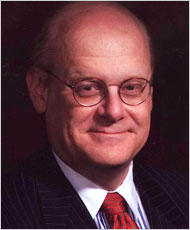
Allen C. Guelzo
Allen C. Guelzo

Allen C. Guelzo is a renowned American historian born in 1953. He has a deep expertise in the field of history, particularly in the study of the American Civil War. Professor Guelzo has held teaching positions at several academic institutions, including William & Mary and Georgetown University. His academic career began with a passion for history, which has evolved into a unique scholarly style over the years. more

You May Also Like

“One thing which Stephen A. Douglas was temperamentally incapable of doing was admitting he was wrong. He always believed that 'popular sovereignty' - the core doctrine of the Kansas-Nebraska Bill - was the right solution to the slavery controversy; and even though it had failed to solve much of anything in Kansas and Nebraska, he stubbornly insisted that this was because it had never been adequately tested.”

“We still know so little about how the brain interacts with the body chemistry or, for that matter, whether we should be talking about the brain or the mind, that it would be perilous to hazard any guess about the way Abraham Lincoln's biological health may or may not have affected him. Of course, we don't have Lincoln on hand to ask him directly; but even if we did, we still might not be able to make sense of how all the parts worked together.”

“Abraham Lincoln did have intellectual instincts, a tremendous curiosity on a broad range of subjects, and a near-photographic memory for what he read. He was, at the end of the day, a politician: politics were his heaven, said William Herndon. But Lincoln did take comfort in ideas and books, more so than almost any other president, and he went to books and ideas in moments of perplexity to sort things out. Philosopher, no, but thoughtful and "surprisingly well-read" for his day.”

“Until the early 90s, when I was working on a project about the idea of free will in American philosophy. I knew that Lincoln had had something to say about "necessity" and "fatalism," and so I began writing him into the book. In fact, Lincoln took over. I wrote instead 'Abraham Lincoln: Redeemer President,' in 1999, and I've splitting rails with Mr. Lincoln ever since. If there's a twelve-step process for this somewhere, I haven't found it yet.”