“No government can be maintained without the principle of fear as well as duty. Good men will obey the last, but bad ones the former only. If our government ever fails, it will be from this weakness.”
Quote by Thomas Jefferson
Work
The Papers of Thomas Jefferson, Retirement Series, Volume 7: 28 November 1813 to 30 September 1814
The Papers of Thomas Jefferson, Retirement Series, Volume 7 is a scholarly compilation that includes letters, notes, and other writings by Thomas Jefferson during his retirement years. This volume offers insights into Jefferson's personal thoughts and activities during a significant period in American history. more
Author
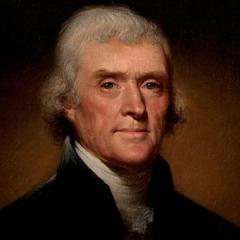
Thomas Jefferson
Thomas Jefferson was the third President of the United States, a distinguished politician, philosopher, architect, and scientist. He was born on April 13, 1743, and died on July 4, 1826. Jefferson advocated for democracy and freedom in politics and was one of the main authors of the Declaration of Independence. His political ideas had a profound impact on the founding and development of the United States. more
You May Also Like
Source: Jefferson: Political Writings
“I... [am] convinced [man] has no natural right in opposition to his social duties.”
Source: John Dewey Presents the Living Thoughts of Thomas Jefferson
Source: The writings of Thomas Jefferson: being his autobiography, correspondence, reports, messages, addresses, and other writings, official and private
Source: Memoir, correspondence, and miscellanies from the papers of T. Jefferson
Source: The writings of Thomas Jefferson: being his autobiography, correspondence, reports, messages, addresses, and other writings, official and private
“Lethargy is the forerunner of death to the public liberty.”
Source: The Essential Jefferson
Source: Jefferson: Political Writings
Source: Jefferson: Writings
Source: The Real Thomas Jefferson