Quotessence
Home / Quotes / Quote by Thomas Jefferson

Quote by Thomas Jefferson

Work

The Essential Jefferson

This book compiles a selection of Thomas Jefferson's most significant works, including his political essays, correspondence, and personal reflections. It offers insight into his ideas on democracy, governance, and the role of the individual in society. The collection provides a detailed look at Jefferson's intellectual development and his influence on the formation of the United States. more

Author
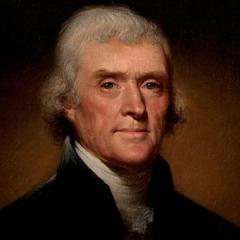
Thomas Jefferson
Thomas Jefferson

Thomas Jefferson was the third President of the United States, a distinguished politician, philosopher, architect, and scientist. He was born on April 13, 1743, and died on July 4, 1826. Jefferson advocated for democracy and freedom in politics and was one of the main authors of the Declaration of Independence. His political ideas had a profound impact on the founding and development of the United States. more

You May Also Like

“The most effectual means of preventing the perversion of power into tyranny are to illuminate, as far as practicable, the minds of the people at large, and more especially to give them knowledge of those facts which history exhibits, that possessed thereby of the experience of other ages and countries, they may be enabled to know ambition under all its shapes, and prompt to exert their natural powers to defeat its purposes.”

“Most codes extend their definitions of treason to acts not really against one's country. They do not distinguish between acts against the government, and acts against the oppressions of the government. The latter are virtues, yet have furnished more victims to the executioner than the former. Real treasons are rare; oppressions frequent. The unsuccessful strugglers against tyranny have been the chief martyrs of treason laws in all countries.”

“Time indeed changes manners and notions, and so far we must expect institutions to bend to them. But time produces also corruption of principles, and against this it is the duty of good citizens to be ever on the watch, and if the gangrene is to prevail at last, let the day be kept off as long as possible.”

“A single good government becomes... a blessing to the whole earth, its welcome to the oppressed restraining within certain limits the measure of their oppressions. But should even this be counteracted by violence on the right of expatriation, the other branch of our example then presents itself for imitation: to rise on their rulers and do as we have done.”

“A first attempt to recover the right of self government may fail, so may a second, a third, etc. But as a younger and more instructed race comes on, the sentiment becomes more and more intuitive, and a fourth, a fifth, or some subsequent one of the ever renewed attempts will ultimately succeed... To attain all this, however, rivers of blood must yet flow, and years of desolation pass over; yet the object is worth rivers of blood and years of desolation. For what inheritance so valuable can man leave to his posterity?”

“A government regulating itself by what is wise and just for the many, uninfluenced by the local and selfish views of the few who direct their affairs, has not been seen, perhaps, on earth. Or if it existed for a moment at the birth of ours, it would not be easy to fix the term of its continuance. Still, I believe it does exist here in a greater degree than anywhere else; and for its growth and continuance... I offer sincere prayers.”

“May [our Declaration of Independence] be to the world, what I believe it will be (to some parts sooner, to others later, but finally to all), the signal of arousing men to burst the chains under which monkish ignorance and superstition had persuaded them to bind themselves, and to assume the blessings and security of self-government... All eyes are opened, or opening, to the rights of man.”