Quotessence
Home / Quotes / Quote by Thomas Carlyle

Quote by Thomas Carlyle

“There is a perennial nobleness, and even sacredness, in work. Were he never so benighted, forgetful of his high calling, there is always hope in a man that actually and earnestly works: in idleness alone there is perpetual despair.”

Quote by Thomas Carlyle

Work

Past and Present

This book delves into the analysis of past events and their relevance to the present day, offering a nuanced understanding of historical context and its implications on modern society. more

Author

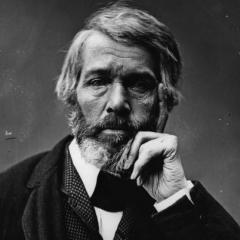
Thomas Carlyle
Thomas Carlyle

Thomas Carlyle, born on December 4, 1795, and died on February 5, 1881, was a prominent Scottish philosopher, historian, and writer. His works are known for their profound social criticism and unique literary style, which had a significant impact on 19th-century British literature and thought. more

You May Also Like

“Who works for glory misses oft the goal; Who works for money coins his very soul Work for the work's sake, then, and it may be, That this thing shall be added unto thee.”

“Letter to the committee in charge of the celebration of the centennial of the American Constitution. I have always regarded that Constitution as the most remarkable work known to me in modern times to have been produced by the human intellect, at a single stroke (so to speak), in its application to political affairs.”

“Changes in society are due chiefly to the development of the internal contradictions in society, that is, the contradiction between the productive forces and the relations of production, the contradiction between classes and the contradiction between the old and the new; it is the development of these contradictions that pushes society forward and gives the impetu6 for the suppression of the old society by the new.”

“The ruthless economic exploitation and political oppression of the peasants by the landlord class forced them into numerous uprisings against its rule.... It was the class struggles of the peasants, the peasant uprisings and peasant wars that constituted the real motive force of historical development in Chinese feudal society.”

“In the final analysis, national struggle is a matter of class struggle. Among the whites in the United States, it is only the reactionary ruling circles that oppress the black people. They can in no way represent the workers, farmers, revolutionary intellectuals and other enlightened persons who comprise the overwhelming majority of the white people.”

“It is up to us to organize the people. As for the reactionaries in China, it is up to us to organize the people to overthrow them. Everything reactionary is the same; if you do not hit it, it will not fall. This is also like sweeping the floor; as a rule, where the broom does not reach, the dust will not vanish of itself.”

“Our enemies are all those in league with imperialism - the warlords, the bureaucrats, the comprador class, the big Landlord class and the reactionary section of the intelligentsia attached to them. The leading force in our revolution is the industrial proletariat. Our closest friends are the entire semi-proletariat and petty bourgeoisie. As for the vacillating middle bourgeoisie, their right wing may become our enemy and their left wing may become our friend - but we must be constantly on our guard and not let them create confusion within our ranks.”

“Whoever sides with the revolutionary people is a revolutionary. Whoever sides with imperialism, feudalism and bureaucrat-capitalism is a counter-revolutionary. Whomever sides with the revolutionary people in words only but acts otherwise is a revolutionary in speech. Whoever sides with the revolutionary people in deed as well as in word is a revolutionary in the full sense.”