Quotessence
Home / Quotes / Quote by Baron de Montesquieu

Quote by Baron de Montesquieu

Work

The Spirit of Laws

Written by Charles de Secondat, Baron de Montesquieu, this seminal work explores the relationship between law, political institutions, and social order. It delves into the principles of separation of powers and the impact of climate and geography on the formation of laws and governments. more
Author

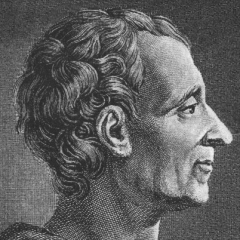
Baron de Montesquieu

Baron de Montesquieu, a French Enlightenment thinker, jurist, historian, and politician, was born on January 18, 1689, and died on February 10, 1755. He is one of the most important thinkers in the history of Western political thought, known for his contributions to the theory of the separation of powers. more

You May Also Like

“Our practical choice is not between a tax-cut deficit and a budgetary surplus. It is between two kinds of deficits: a chronic deficit of inertia, as the unwanted result of inadequate revenues and a restricted economy; or a temporary deficit of transition, resulting from a tax cut designed to boost the economy, increase tax revenues, and achieve -- and I believe this can be done -- a budget surplus. The first type of deficit is a sign of waste and weakness; the second reflects an investment in the future.”

“For in a government of laws and not of men, no man, however prominent or powerful, and no mob however unruly or boisterous, is entitled to defy a court of law. If this country should ever reach the point where any man or group of men by force or threat of force could long defy the commands of our court and our Constitution, then no law would stand free from doubt, no judge would be sure of his writ, and no citizen would be safe from his neighbors.”

“Third, and finally, the educated citizen has an obligation to uphold the law. This is the obligation of every citizen in a free and peaceful society--but the educated citizen has a special responsibility by the virtue of his greater understanding. For whether he has ever studied history or current events, ethics or civics, the rules of a profession or the tools of a trade, he knows that only a respect for the law makes it possible for free men to dwell together in peace and progress.”

“First, what does truth require? It requires us to face the facts as they are, not to involve ourselves in self-deception; to refuse to think merely in slogans. If we are to work for the future of the city, let us deal with the realities as they actually are, not as they might have been, and not as we wish they were.”