Quotessence
Home / Quotes / Quote by Theodore Roosevelt

Quote by Theodore Roosevelt

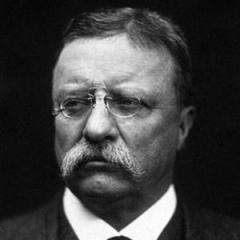
“If we say of a boy or a man, "He is of good character," we mean that he does not do a great many things that are wrong, and we also mean that he does do a great many things which imply much effort of will and readiness to face what is disagreeable. He must not steal, he must not be intemperate, he must not be vicious in any way; he must not be mean or brutal; he must not bully the weak. In fact, he must refrain from whatever is evil. But besides refraining from evil, he must do good.”

Quote by Theodore Roosevelt

Work

Strenuous Life

Browse quotes and source details for this work. more

Author

Theodore Roosevelt
Theodore Roosevelt

Theodore Roosevelt was the 26th President of the United States, serving from 1901 to 1909. A progressive leader, he is known for his advocacy of the conservation movement, expansion of federal government regulation, and efforts to improve the lives of American citizens. more

You May Also Like

“Maria, lonely prostitute on a street of pain, You, at least, hail me and speak to me While a thousand others ignore my face. You offer me an hour of love, And your fees are not as costly as most. You are the madonna of the lonely, The first-born daughter in a world of pain. You do not turn fat men aside, Or trample on the stuttering, shy ones, You are the meadow where desperate men Can find a moment's comfort. Men have paid more to their wives To know a bit of peace And could not walk away without the guilt That masquerades as love. You do not bind them, lovely Maria, you comfort them And bid them return. Your body is more Christian than the Bishop's Whose gloved hand cannot feel the dropping of my blood. Your passion is as genuine as most, Your caring as real! But you, Maria, sacred whore on the endless pavement of pain, You, whose virginity each man may make his own Without paying ought but your fee, You who know nothing of virgin births and immaculate conceptions, You who touch man's flesh and caress a stranger, Who warm his bed to bring his aching skin alive, You make more sense than stock markets and football games Where sad men beg for virility. You offer yourself for a fee--and who offers himself for less? At times you are cruel and demanding--harsh and insensitive, At times you are shrewd and deceptive--grasping and hollow. The wonder is that at times you are gentle and concerned, Warm and loving. You deserve more respect than nuns who hide their sex for eternal love; Your fees are not so high, nor your prejudice so virtuous. You deserve more laurels than the self-pitying mother of many children, And your fee is not as costly as most. Man comes to you when his bed is filled with brass and emptiness, When liquor has dulled his sense enough To know his need of you. He will come in fantasy and despair, Maria, And leave without apologies. He will come in loneliness--and perhaps Leave in loneliness as well. But you give him more than soldiers who win medals and pensions, More than priests who offer absolution And sweet-smelling ritual, More than friends who anticipate his death Or challenge his life, And your fee is not as costly as most. You admit that your love is for a fee, Few women can be as honest. There are monuments to statesmen who gave nothing to anyone Except their hungry ego, Monuments to mothers who turned their children Into starving, anxious bodies, Monuments to Lady Liberty who makes poor men prisoners. I would erect a monument for you-- who give more than most-- And for a meager fee. Among the lonely, you are perhaps the loneliest of all, You come so close to love But it eludes you While proper women march to church and fantasize In the silence of their rooms, While lonely women take their husbands' arms To hold them on life's surface, While chattering women fill their closets with clothes and Their lips with lies, You offer love for a fee--which is not as costly as most-- And remain a lonely prostitute on a street of pain. You are not immoral, little Maria, only tired and afraid, But you are not as hollow as the police who pursue you, The politicians who jail you, the pharisees who scorn you. You give what you promise--take your paltry fee--and Wander on the endless, aching pavements of pain. You know more of universal love than the nations who thrive on war, More than the churches whose dogmas are private vendettas made sacred, More than the tall buildings and sprawling factories Where men wear chains. You are a lonely prostitute who speaks to me as I pass, And I smile at you because I am a lonely man.”

“What a strange business this acting is, Pyke said; you are trying to convince people that you're someone else, that this is not-me. The way to do it is this, he said: when in character, playing not-me, you have to be yourself. To make your not-self real you have to steal from your authentic self. A false stroke, a wrong note, anything pretended, and to the audience you are as obvious as a Catholic naked in a mosque. The closer you play to yourself the better. Paradox of paradoxes: to be someone else successfully you must be yourself! This I learned!”