Quotessence
Home / Quotes / Quote by John Stuart Mill

Quote by John Stuart Mill

“A person whose desires and impulses are his own - are the expression of his own nature, as it has been developed and modified by his own culture - is said to have a character. One whose desires and impulses are not his own, has no character, no more than a steam-engine has character.”

Quote by John Stuart Mill

Work

On Liberty, Utilitarianism and Other Essays

This book is a compilation of essays that delve into the concepts of individual liberty, the ethical theory of utilitarianism, and broader moral philosophical considerations. The essays are known for their insightful analysis and contribution to the fields of ethics and political philosophy. more

Author
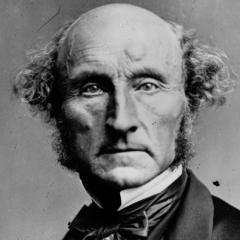
John Stuart Mill
John Stuart Mill

John Stuart Mill was an influential British philosopher, economist, and logician. He is one of the most important figures in 19th-century philosophy and his ideas had a profound impact on political, social, and philosophical thought of the time. more

You May Also Like

“The Divine was beyond description, beyond knowing, beyond comprehension. To say that the Divine was Creation divided by Destruction was as close as one could come to definition. But the puny of soul, the dull of wit, weren't content with that. They wanted to hang a face on the Divine. They went so far as to attribute petty human emotions - anger, jealousy, etc - to it, not stopping to realize that if God were a being, even a supreme being, our prayers would have bored him to death long ago.”

“The Divine was expansive, but religion was reductive. Religion attempted to reduce the Divine to a knowable quantity with which mortals might efficiently deal, to pigeonhole it once and for all so that we never had to reevaluate it. With hammers of cant and spikes of dogma, we crucified and crucified again, trying to nail to our stationary altars the migratory light of the world.”

“Life knows us not and we do not know life—-we don’t know even our own thoughts. Half the words we use have no meaning whatever and of the other half each man understands each word after the fashion of his own folly and conceit. Faith is a myth and beliefs shift like mists on the shore; thoughts vanish; words, once pronounced, die; and the memory of yesterday is as shadowy as the hope of tomorrow”

“I have not much patience with a certain class of Christians nowadays who will hear anybody preach so long as they can say, 'He is very clever, a fine preacher, a man of genius, a born orator.' Is cleverness to make false doctrine palatable? Why, sirs, to me the ability of a man who preaches error is my sorrow rather than my admiration.”