Quotessence
Home / Quotes / Quote by Leo Tolstoy

Quote by Leo Tolstoy

“It was long before I could believe that human learning had no clear answer to this question. For a long time it seemed to me, as I listened to the gravity and seriousness wherewith Science affirmed its positions on matters unconnected with the problem of life, that I must have misunderstood something. For a long time I was timid in the presence in learning, and I fancied that the insufficiency of the answers which I received was not its fault, but was owing to my own gross ignorance, but this thing was not a joke or a pastime with me, but the business of my life, and I was at last forced, willy-nilly, to the conclusion that these questions of mine were the only legitimate questions underlying all knowledge, and that it was not I that was in fault in putting them, but science in pretending to have an answer for them.”

Quote by Leo Tolstoy

Work

A Confession

Browse quotes and source details for this work. more

Author
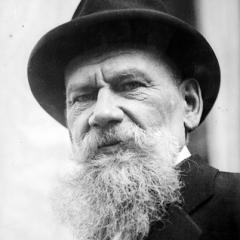
Leo Tolstoy
Leo Tolstoy

Leo Tolstoy was a Russian writer and thinker, a prominent representative of 19th-century Russian literature. His works deeply revealed social contradictions and human nature, and had a profound impact on the world. more

You May Also Like

“The Head of the Charles in Cambridge, Mass., is the great American crew event, athletically and socially. It occurs the second weekend in October; secondary schools and colleges send shells in all categories in the three-mile race up the Charles River. Drunken Preps line the banks and bridges at Harvard, ready to howl with glee as a coxswain rams his shell into a stanchion of the Eliot Street Bridge (where the river narrows and curves with treacherous suddenness).”

“Change in fashion is simply the expression of an awakened intellect, groping in small things as in great for something better than it has known; and the use for a manual of fashion, such as we offer is, not to dictate to women any rule which they must blindly follow, but to afford such knowledge of varying costumes, and the manner of making them, that each may clothe herself appropriately, according to her appearance of age, or even mood. Why should not a woman's purity of mind, her quick eye for color, her aesthetic sense of fitness, be disclosed in her attire as well as in the pictures on her walls or her garden? Very few of us will ever carve a great statue, or paint a great picture but we all have clothes to wear; and it is a duty we owe to ourselves and those around us, to so drape the bodies that God has given us, as to make no discord in this beautiful, pleasant world. All of us have friends, or, it may be, children, with whom we would have a fair and tender memory. Carelessness and bad taste in dress, so far from being indicative of strength of mind, argues a certain vulgarity of feeling, just as vanity and foppery, on the other hand, prove a weak brain. Wise men or women make their dress so thoroughly in accordance with their person and character, that nobody notices it any more than the frame of a picture; but to be clothed shabbily, in the hopes that our inner perfections will overshadow our dress, is but the extreme of vanity. Peterson's Magazine, June 1873”

“After the birth of printing books became widespread. Hence everyone throughout Europe devoted himself to the study of literature... Every year, especially since 1563, the number of writings published in every field is greater than all those produced in the past thousand years. The Paracelsians have created medicine anew and the Copernicans have created astronomy anew. I really believe that at last the world is alive, indeed seething, and that the stimuli of these remarkable conjunctions did not act in vain.”