Quotessence
Home / Quotes / Quote by Herbert Spencer

Quote by Herbert Spencer

Work

Social Statics: Great Essays

This book is a compilation of essays that delve into the realms of social and political philosophy, offering insights and analyses on various societal issues. more

Author
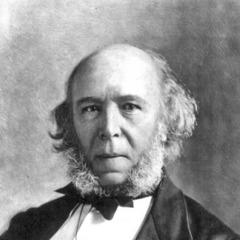
Herbert Spencer
Herbert Spencer

Herbert Spencer was an English philosopher, sociologist, and writer, best known for his theory of social Darwinism. His ideas had a profound impact on social and political theories of the late 19th century. more

You May Also Like

“Each new ontological theory, propounded in lieu of previous ones shown to be untenable, has been followed by a new criticism leading to a new scepticism. All possible conceptions have been one by one tried and found wanting; and so the entire field of speculation has been gradually exhausted without positive result: the only result reached being the negative one above stated, that the reality existing behind all appearances is, and must ever be, unknown.”

“Under the natural course of things each citizen tends towards his fittest function. Those who are competent to the kind of work they undertake, succeed, and, in the average of cases, are advanced in proportion to their efficiency; while the incompetent, society soon finds out, ceases to employ, forces to try something easier, and eventually turns to use.”

“Unlike private enterprise which quickly modifies its actions to meet emergencies - unlike the shopkeeper who promptly finds the wherewith to satisfy a sudden demand - unlike the railway company which doubles its trains to carry a special influx of passengers; the law-made instrumentality lumbers on under all varieties of circumstances at its habitual rate. By its very nature it is fitted only for average requirements, and inevitably fails under unusual requirements.”

“People ... become so preoccupied with the means by which an end is achieved, as eventually to mistake it for the end. Just as money, which is a means of satisfying wants, comes to be regarded by a miser as the sole thing to be worked for, leaving the wants unsatisfied; so the conduct men have found preferable because most conducive to happiness, has come to be thought of as intrinsically preferable: not only to be made a proximate end (which it should be), but to be made an ultimate end, to the exclusion of the true ultimate end.”